Recently I came across the word “parergon”, which was new to me. When I looked it up, I learned that it refers to “a piece of work that is supplementary to or a byproduct of a larger work” (Oxford) or “a supplementary issue or embellishment” (wikipedia). It is something (ornament or frame for art, appendix to a book, etc.) that supplements the “ergon”, the primary work. I hadn’t encountered “ergon” either, but hey! It rings a bell from “ergonomics”, which refers to “the study of people’s efficiency in their working environment” (Oxford again). The common root “erg” refers to work. Nifty!
Parergon apparently can also refer to an activity outside of your main occupation (hobby, presumably, or what today would be called a “side hustle” if you’re making money from it). May we all have many parerga – it’s not all about the ergon!
Airplane instrument approaches to airports allow you to fly safely through clouds (or in the dark) without running into terrain or obstacles. They specify the path to fly and the minimum altitude for each segment. Individual obstacles (hills, towers, etc.) are also charted as an additional warning for things to avoid.
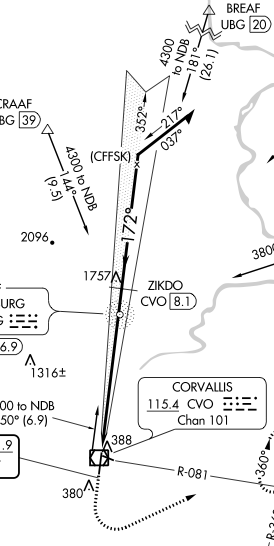
One example is the ILS approach to runway 17 at the Corvallis (KCVO) airport. An excerpt is shown at right. You fly along the thick black line from top-to-bottom on this chart (with a heading of 172 degrees) to get to runway 17, which is near the icon marked with the “CVO” bubble (this is actually the VOR but it’s close to the approach end of RW 17).
If you look near the point marked “ZIKDO”, you can see a little pointy icon with “1757” next to it. This indicates an obstacle (tower) that sticks up to 1757 feet above sea level. The procedure specifies that your airplane should be no lower than 2800′ here, and the obstacle shows you exactly why. It’s comforting to know that you have 1000′ of clearance above the highest obstacle as you’re flying along at 100 mph without being able to see the ground.
I have flown this approach several times, and I’ve always either had my foggles on or been in the clouds, so I’d never actually seen the obstacle. It was more of a theoretical entity.
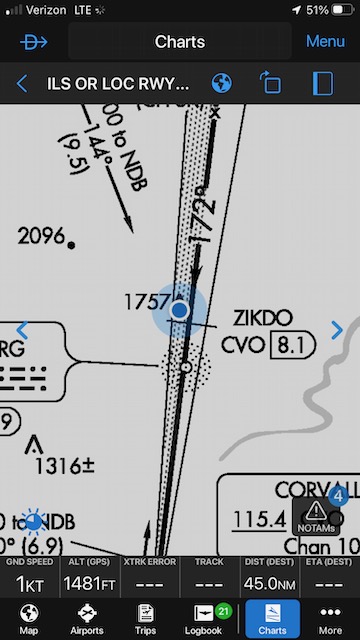
The other day I was out for a hike and realized that the path I was on went right under the ILS 17 approach course. In fact, as I hiked up a hill, I realized that I might be approaching whatever that tall obstacle must be. I pulled up my Garmin Pilot app (generally used when I’m flying, not hiking) and was able to navigate to the ground location of the obstacle near ZIKDO! The blue dot shows my location. The app reports I’m standing at 1481′, so (depending how accurate that is), the tower would be about 275′ tall.
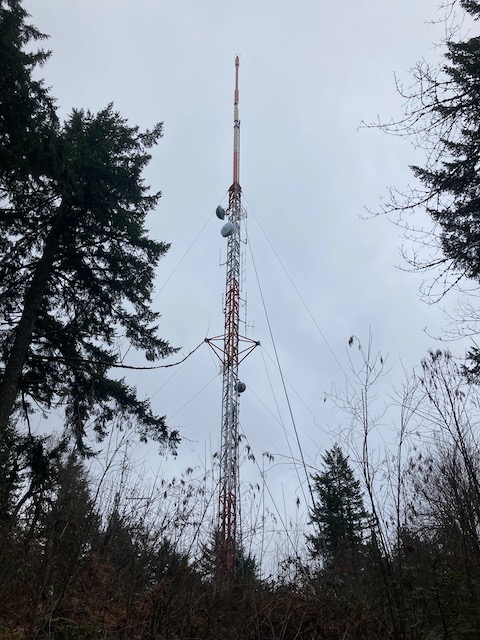
And here is what I found: an impressively tall tower sticking up on top of the hill and certainly not something I’d like to have in close proximity to my airplane:
It was so cool to see it with my own eyes! Locating the obstacle felt a little like an aviation-themed geocaching exercise :) There was no tangible treasure to be found, but now the instrument approach procedure chart feels a little more “grounded”, and I can appreciate all over again the work that goes into formulating these approaches to keep us safe. There’s more to find on this chart alone! I already know the one at 388′ just north of the airport (it’s a water tower, very cool). Maybe sometime I’ll make my way to the tower at 1316′, the hill/mountain at 2096′, or the tower indicated at 380′ south of the airport. Here’s to finding more aero-obstacles!
On February 15, 2023, I took my instrument rating checkride with Lisa Dahl at the Salem, OR, airport (KSLE). That morning, my home airport (KCVO) was covered in thick freezing fog, so I couldn’t fly my plane there as originally planned. Instead, I drove to KSLE and then handed my car keys to an instructor who was kind enough to drive my car to KCVO and fly the plane back to KSLE for me, while I did the oral part of the checkride. We started the oral part at 10 a.m. and finished around 2 p.m. (when the plane showed up), ate a bit of lunch, then went flying for 2 more hours.
Overall, the oral part of the exam was very conversational, and Lisa encouraged me from the start to take notes so I would know what to look into more deeply after the checkride. That was something I’d wanted to do anyway!
Lisa checked my documents, endorsements, and qualifications (training and experience), quizzed me about IFR currency requirements, and discussed my personal mins (guidelines for conditions under which I’d feel comfortable flying IFR). We reviewed the airplane’s inspections and airworthiness and talked through some decision-making scenarios.
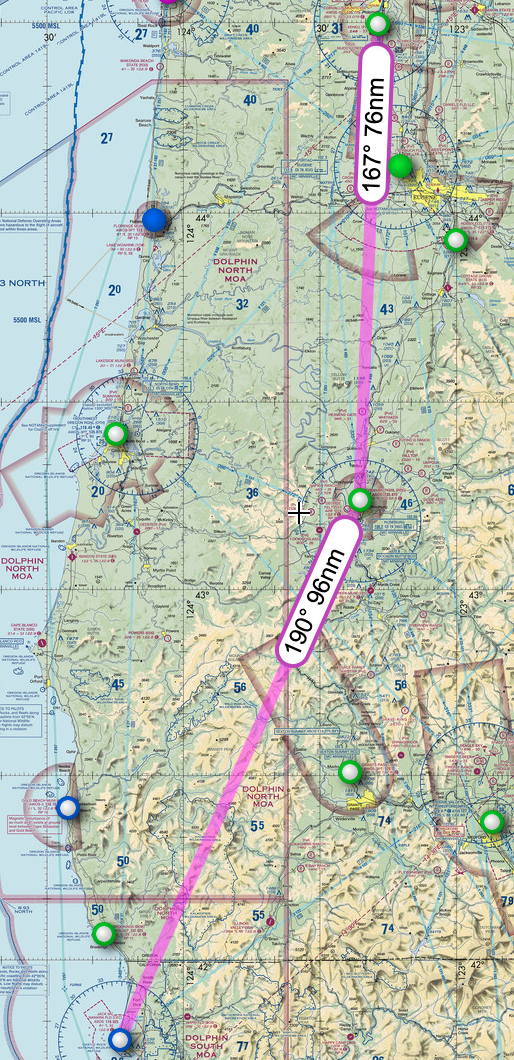
In advance, she’d asked me to plan an IFR flight from KSLE to KRBG (Roseburg, in the hills), then pick up a passenger and fly KRBG to KCEC (Crescent City, on the coast). This was a fun exercise, and I’d spent a lot of time compiling all the details I would want if I were really flying it (route, altitude, weight and balance, fuel requirements, estimated time en route, whom I’d talk to along the way, departure and approach procedures available, takeoff mins, my personal mins, runway properties (including lighting), airport services, NOTAMs, the latest weather that day, special concerns, and alternatives (if no-go on the flight). I brought Google 3D visualizations of the expected approaches to give a visual sense of the terrain (especially KRBG). Most of this we didn’t actually use, but we did talk about en-route altitudes and terrain clearance.
We talked through decision making in scenarios like being in the clouds and discovering you have icing on your plane, or turbulence, and what options you would consider. We looked at KONP (Newport) and how its airspace differs from KCVO’s airspace. We discussed being cleared for a “visual” approach and what that means, then talked through the RNAV B approach at KRBG. I shared my concerns about the steep descent rate required (a VDA (visual descent angle) of 5.36 degrees which is almost twice the typical 3 degrees).
Next we talked about the airplane’s electrical system: battery voltage, bus voltage, alternator failure, how long the battery might last, and that transitioned nicely to a discussion of what to do if you have lose communication. She asked if I would accept a tailwind landing and seemed pleased I had articulated a personal limit for this.
Apparently the oral part was satisfactory, because we proceeded to discuss a plan for our flight. We separated to eat our lunches, then I went out to pre-flight the plane. She joined me and asked a few questions about the plane (cylinders, spark plugs, fuel vents). She had me handle ATC communications while we were IFR and she took over when we were VFR. We flew the SLE4 departure from runway 34 (they gave us a heading of 340 and 4000′). During debrief later, Lisa said not to do a rolling takeoff, which was the first time I’d gotten that advice. (Instead, get on the runway and lined up, pause, final check of heading/runway/etc., then proceed). I’ve only done this for short-field takeoffs. Good to know!
She wanted me to demonstrate one hand-flown approach, one autopilot-coupled, and the other one my choice. We flew the ILS 31 from LOTKE, missed approach, hold at ARTTY, then the LOC BC 13, circle west to a low approach on RW 34. I used the autopilot after departure until we were approaching LOTKE, hand-flew the ILS 31, used the autopilot for the hold and LOC BC 13, then hand-flew everything else. She complimented my handling of approach speed and descent rate. Here I am reporting that we’re coming in on the ILS 31:
and then when we crossed the LOTKE waypoint:
and then when we went missed and were climbing away from the airport:
For the LOC BC 13, after leveling nicely just above MDA, I flipped up the foggles and started inadvertently descending (I think maybe due to the slight disorientation in switching from foggles to visual and simultaneously slowing down – pitching up and reducing power, maybe too much on the latter) and she said to watch altitude, and I quickly caught it. My alignment downwind was good, but in looking at my ground track I judge that I was way too far from the runway. The low approach went well and we climbed out VFR.
We did a sequence of VOR tuning and tracking operations, then everyone’s favorite: unusual attitude recoveries! We returned to the airport with the RNAV 31 approach. We simulated loss of WAAS, so no vertical guidance, and she put a post-it over the HSI to simulate the loss of one G5, so I also had limited lateral guidance. I flared a little high but it was a satisfactory landing. We taxied back to parking and she said that I passed!
Overall it was a great opportunity to go through all of the knowledge and skills that I’ve been working for months to acquire. Lisa gave me what I consider an enormous compliment in saying that I ask all the right questions and she likes how I get into the details of how things work. She encouraged me to get my commercial and CFI certificates and train some students :) I then flew back to KCVO, landing a bit after 7 p.m.!
The real reward for passing the checkride will be getting to fly instruments without foggles on! I can’t wait to see what I’ve been missing!
1 Comments 1 of 1 people learned something from this entry.
I’ve now gotten the chance to fly inside the clouds a few times. It is a breathtaking experience! Most of the time, instrument training is done in “simulated” conditions in which you wear blinders (“foggles”) that block out everything but the instrument panel. But there are still small clues like the feel of the sun on your arm or the slant of shadows, and maybe there’s always a sense in the back of your brain that you COULD remove the foggles if you really WANTED to.
Taking off and plunging into a dense, gray cloud with your eyes wide open feels a lot different. There is a “fwoosh” moment on entry – I’m not sure if it’s actually audible or just the mental experience of being enveloped and losing all visual references. The temperature drops, sounds seem a little different, and you think, “Okay, this is for REAL.” 90% of your brain gets busy processing the instruments which are now your only lifeline, while 10% sits in the back thinking “I’m hurtling through the air at 100 mph and I CAN’T SEE.” You have to suppress that part of your brain. :)
Then you observe that it isn’t that different from all the practice you’ve been doing. The plane still responds the same and you’re still tracking your GPS course or VOR needles or other navigational aid. However, it *can* get more bumpy, and now you need to remember to look outside every now and then – not because you can see anything of use for navigation, but to check for any signs of ice accumulating on your airplane.
The first time I flew into the cloud, it was a benign layer sitting above the airport that we tunneled through on the way up and then back down, up, down doing practice instrument approaches. The second time, the clouds were piled up unevenly at our altitude so we flew in and out of them horizontally, getting spatterings of rain and finding small pockets of clear air (but cloud below) before we plunged into the next gray wall. The in-and-out was a little distracting, plus the plane took a little more management, but it was great to see various ways that clouds can manifest for real.
I look forward to getting more experience with clouds. Certainly not all of them are clouds you want to fly into, but knowing how to handle reduced visibility is an excellent skill to have.
1 Comments 0 of 1 people learned something from this entry.
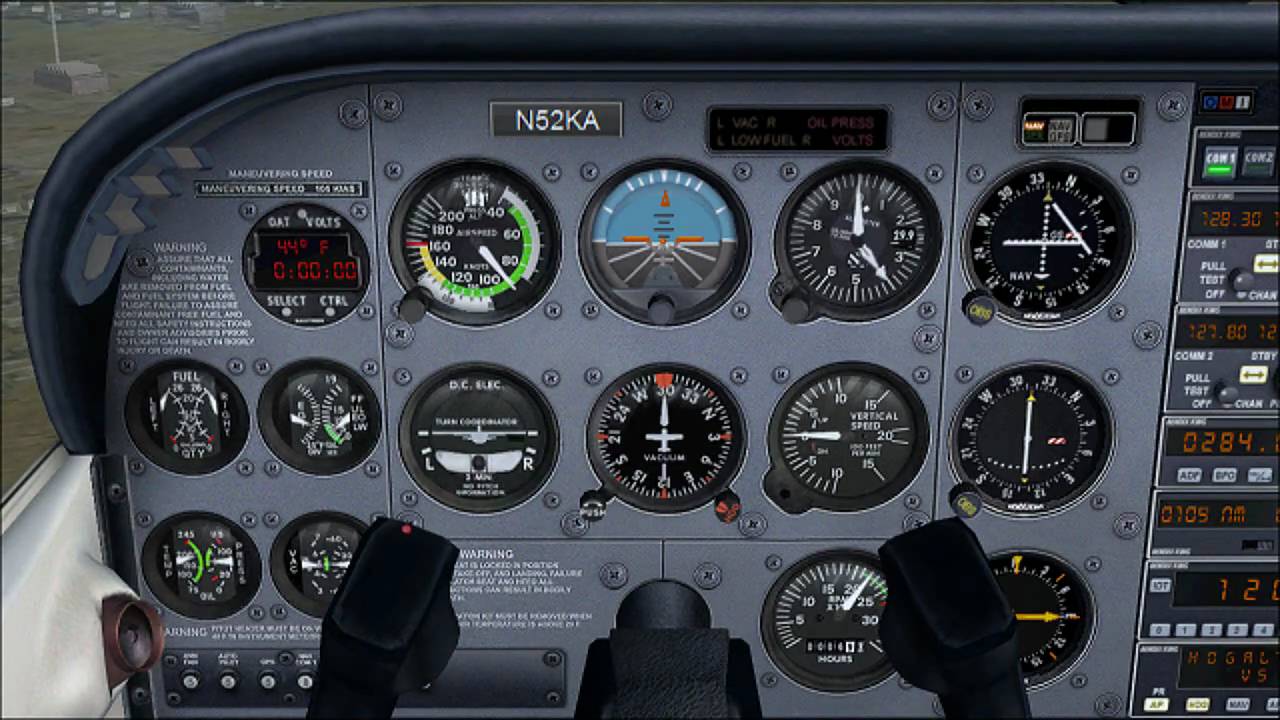
For my second instrument training lesson (August 14), I got to fly to another airport wearing a “view limiting device” that blocks all peripheral vision so all you can see is the instrument panel in front of you. Your view is something very like this:
For this flight, we took off from Corvallis (KCVO) and flew to a nearby intersection in the air (SHEDD), then turned south for our destination, Hobby Field (Creswell, 77S).
I had filed the flight plan beforehand, and we got our clearance to 77S in the air. I then learned about the next step, which is to get the current weather at 77S and then request a particular approach to your destination. In this case, we asked for “the RNAV 16 approach to Creswell, to full stop, starting at ALFOR.”
While heading to ALFOR and maintaining your course and altitude and airspeed and five other things, you brief (talk through) your approach. One mnemonic to help you along is MARTHA:
Missed approach: what to do if the clouds are too low for you to land (or winds or turbulence or any other reason you’d rather not do it right then)
ATIS (weather) and Altimeter setting
Radios set so we can talk to the right people and navigate to the right destination
Time: in case it’s a timed approach (this one isn’t)
Heading: to get aligned with the final approach, 159 degrees (southeast)
Altitude: start at or above 3800′, then descending as indicated on the approach plate
At ALFOR, you begin following a series of named waypoints that allow you to get progressively lower until you can line up and land. These all have 5-letter names, and the RNAV 16 approach sequence begins to feel like a magic charm: ALFOR, IYAYE, WOSLO, ZEMAM, UWZAB. Somewhere after here, my instructor declared that we’d broken through the “clouds” and I could remove my hood and land the plane. The approach brings you in lined up for runway 16 (headed south), but the wind was from the north, so we did a “circling” approach, which just meant flying into the downwind for runway 34 and landing normally. If the clouds don’t magically clear before you descend to (in this case) 1041′, you execute the “missed approach” to fly away and either try again or go elsewhere to land.
We departed using the HOBBY TWO obstacle departure procedure, which is designed to keep you safe from the surrounding hills (although note the extensive list of trees, poles, fences, etc.!). I put the hood on while we were climbing out, so I couldn’t see the hills anyway. (Which is okay because my instructor was watching them carefully :) ) We then flew back to KCVO, along the way requesting the RNAV 35 approach there. The associated magic incantation is DERAY, WENKA, ACOTY, CESDO. This time we flew the approach from DERAY, then pretended that we were still in clouds so did the missed approach back to DERAY, and flew it again.
Flying with the hood on is challenging. It took all of my concentration to try to keep the plane on the heading to the airport, descending at the correct rate, good airspeed, etc. There’s so much that you subconsciously process and respond to when you can see the world outside your plane! When that is taken away, you have to stare at the dials and reconstruct your spatial position and trajectory and translate that into the right control adjustments – pitch, power, bank, and rudder. On our first approach to runway 35, I ended up offset from the actual runway (when finally allowed to look!), but the second approach was much better (and that’s the one we landed from). I’ll keep working on refining it!