Maps at the Library of Congress

Today I learned about the impressive collection of maps held by the Library of Congress, which has the largest map library in the world (6 million items). These items are publicly available to anyone with a (free) Library of Congress card, and there are also a lot of digital maps available online.

The Geography and Maps Division is currently featuring key maps from the American Revolution period (to commemorate the U.S.’s 250th anniversary). These 1,470 maps include a map of Philadelphia that includes a sketch of the State House where the Continental Congress met to hash out the Declaration of Independence, a Rochambeau map of the 1776 Battle of Long Island, the first map of the United States showing them as an independent country (1783), and more.


First map of the United States as an independent country (1783)

They also have an collection of Revolution era maps made accessible to visually impaired individuals. They have created “tactile maps” that reproduce maps with raised outlines, Braille labels, and textures, as well as audio descriptions of the maps. To make these tactile maps, they first choose maps likely to translate well to this form (ideally not too complicated), identify lines and edges, add Braille labels, then add texture to shade different regions. The maps are printed with a regular printer, on special paper, then heated and the places with ink swell into ridges you can feel. Awesome!
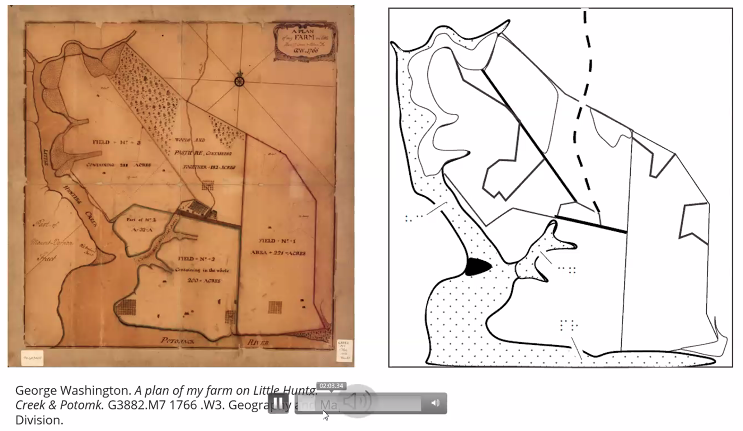
Example of tactile map design
My screenshot of the tactile map example during the June 9 webinar

Finally, the “By the People” program at the Library of Congress, where you can volunteer to help transcribe handwritten materials, will soon be launching a project to transcribe nautical maps from the Atlantic Neptune Collection. It should show up at By the People when it opens. You can help enrich this collection!

What is left over after ten

Some things come along so early in our language learning that we never think to wonder about them.

Our English numbers “eleven” and “twelve” fall into this category for me. They don’t follow the later “teens” pattern – why not “oneteen” and “twoteen” or some variant?

Recently I learned why! According to etymoline.com, eleven leaves the reference to ten totally implicit and just refers to having one more than [ten], or “one left” (after counting ten):

eleven (num.): “1 more than ten; the number which is one more than ten; a symbol representing this number;” c. 1200, elleovene, from Old English enleofan, endleofan, literally “one left” (over ten)

and the same thing happened for twelve (“two left”):

twelve (num.): Old English twelf “twelve,” literally “two left” (over ten), from Proto-Germanic *twa-lif-, a compound of *twa– (from PIE root *dwo– “two”) + *lif– (from PIE root *leikw– “to leave”)

Note: “PIE root” means for a Proto-Indo-European root that has been reconstructed due to common occurrences across multiple languages.

However, the pattern changes when we get to thrilve thirteen, at least in English. And etymonline notes that

Outside Germanic the only instance of this formation is in Lithuanian, which uses –lika “left over” and continues the series to 19 (vienuo-lika “eleven,” dvy-lika “twelve,” try-lika “thirteen,” keturio-lika “fourteen,” etc.).”

Words are never just words; they impact how we live and think, too. We have separate terms for kids in their “tweens” (before 13) and “teens” (13+). Those terms carry different expectations in terms of maturity, hormonal activity, appetite, need for sleep, etc. Would we have this conceptual division if our numbers, as in Lithuanian, were more regular for the full range 11-19? Maybe, maybe not.

Moonshot programming

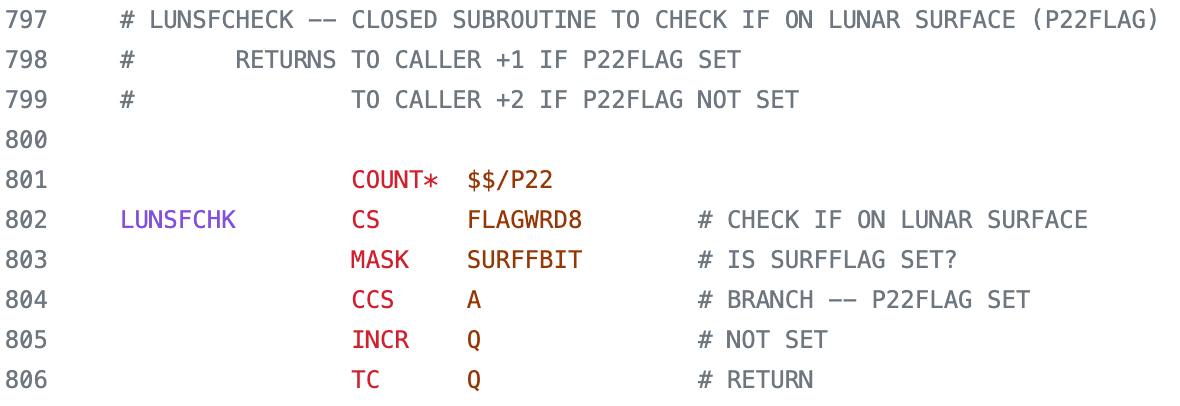
This iconic image shows Margaret Hamilton standing next to a printout of the flight software that she and her team wrote to control the Apollo Guidance Computer. I recently discovered that the code has been made available via a scan of the printouts, later re-typed as code, and uploaded to GitHub. The code is written in assembly, which consists of individual instructions to load, calculate, and act on data values. Today we use compilers so we can write code in higher-level languages that are easily understandable by humans, but at the time compilers were still pretty new, and the available memory was so limited that they wanted humans to do the optimization at the individual instruction level. Wow!

Here’s an example excerpt from the code. Even if you don’t know AGC assembly (I don’t), it’s possible to follow along due to the excellent comments.

I’m in awe of how this massive software engineering project would have proceeded (How did they test it? And without modern version control… did they use periodic printouts in case they found a mistake and wanted to roll back?) What an inspiring project!

Browsing the open issues on the project, they seem dedicated to increasing the quality of the content by carefully proofreading it against the original scans of the code printouts. What a labor of love :) But what a wonderful piece of programming history!

Why it’s called ascorbic acid

Recently I came across this fascinating discussion of the mystery that scurvy posed: a painful and ultimately fatal disease for which the cause was unknown. Was it caused by bacteria? Something in food? Food preservation processes? Overwork? It was a major issue for sailors in the British Royal Navy, including Captain Scott:

Scott and Scurvy

But what makes this an especially captivating story is not how the cause was found, but instead how it was subsequently LOST, impacting many people’s lives for the worse, before being rediscovered. Go read the link above to find out more!

While reading it myself, I came across the word “antiscorbutic” to describe a property of lemons – that they could help prevent scurvy. Anti-scorbutic. Theories even developed that some foods could be “scorbutic” – actively causing scurvy.

And in the end when vitamin C was isolated and demonstrated to conclusively eradicate scurvy (which we now conceive of rather circularly as a lack of vitamin C), it now makes perfect sense that it should also go by the name ascorbic acid: an acid that prevents scurvy. Nice!

Also of interest: the reason we suffer when we don’t ingest enough vitamin C is that our bodies can’t produce it internally but it’s needed for a variety of life maintenance procedures. It turns out that humans are in the minority on this: most animals can manufacture their own vitamin C. We, and guinea pigs and bats and a few others, cannot.

How Phoenix got its name

Recently I discovered how Phoenix, Arizona, got its name. In ancient times, people living in the area dug a bunch of canals (135 miles of them!) to direct water from the Salt River to the plains where they were growing crops. In 1867, the area was colonized by white settlers who also dug canals and named the town Swilling’s Mill (after founder Jack Swilling). Darrell Duppa suggested the name Phoenix, “inasmuch as the new town would spring from the ruins of a former civilization.” I think this is pretty cool – a recognition (however subtle) that history didn’t begin when white pioneers reached an area.

Older entries »