Poets and loss

He was a man of independence and learning, with passion for his convictions and love for nature. But less often do we hear of Thoreau’s feelings towards women. His biographers note his marriage proposal to Ellen Seawall (who rejected him) and the love poems he sent to Mary Russell (whom he never proposed to). More mysteriously, Thoreau himself wrote in his diary:

“The obstacles which the heart meets with are like granite blocks which one alone cannot move. She who was as the morning light to me is now neither the morning star nor the evening star. We meet but to find each other further asunder, and the oftener we meet the more rapid our divergence. So a star of the first magnitude pales in the heavens, not from any fault in the observer’s eye nor from any fault in itself, perchance, but because its progress in its own system has put a greater distance between.”

This was however recorded 10 years after his compositions for Mary. Was he looking back on the past? Or was he enamored of another, whose ardor for him had dimmed? No matter the reason, this poignant prose speaks of a loss and melancholy that reaches across the years to today.

[Thanks to The Blog of Henry David Thoreau, which posts excerpts from his diaries on a daily basis.]

Robert Frost had some similar sentiments to share:

Ah, when to the heart of man
Was it ever less than a treason
To go with the drift of things,
To yield with a grace to reason,
And bow and accept the end
Of a love or a season?
— Reluctance

This treason of acceptance is, however painful, a part of life. But our poets can take that moment and paint it in beautiful words and hang it on the wall for us to acknowledge, and consider, and deliberate upon. Who does not prefer, in theory, to yield with grace to reason? And yet who does not find it, in reality, to be all-nigh unbearable?

Juneteenth: the slaves are free

Today was not only the day before Father’s Day, but also a day to commemorate the end of slavery in the United States. Inspired by a brief note on NPR this morning, I learned that June 19, or “Juneteenth”, is a holiday that originated in Texas and is now observed by 35 states (including California but not including Utah). President Lincoln’s Emancipation Proclamation took effect in 1863, but Texas was a hold out, and eventually 2,000 troops (!) had to be sent out to Texas in 1865 to enforce the Proclamation. Wikipedia relates that “legend has it” that General Granger read this statement aloud on June 19:

The people of Texas are informed that, in accordance with a proclamation from the Executive of the United States, all slaves are free. This involves an absolute equality of personal rights and rights of property between former masters and slaves, and the connection heretofore existing between them becomes that between employer and hired labor. The freedmen are advised to remain quietly at their present homes and work for wages. They are informed that they will not be allowed to collect at military posts and that they will not be supported in idleness either there or elsewhere.

June 19 has become Juneteenth, and it is apparently a vigorous annual celebration, in Texas and around the world.

I find it difficult to imagine what it would have felt like, as a slave, to learn that suddenly you had the same personal and property rights as your heretofore master. And it always gives me pause when I learn about some new slice of our country’s history that it then seems impossible not to have known. I hadn’t realized that it took years for the Emancipation Proclamation to have an effect throughout all the States. Given thought, some delay makes sense, since at the time merely getting the news out must have taken weeks or months. (We today are so used to instantaneous communication!) But the subsequent lag brings home more forcefully what an upheaval this decision was and how difficult it was to bring the country into alignment — by force, in some cases.

I hope that we never need federal troops to step in and force communities to recognize equal marriage rights for all humans.

The line of Mason and Dixon

The Mason-Dixon line today has a lot of cultural significance, since it came to serve as a conceptual boundary between the free states of the North and the slave-holding states of the South during the Civil War. But neither Mason nor Dixon were involved in the Civil War. They weren’t even Americans (gasp!). In fact, they were Englishmen hired a hundred years before the war (in 1763) to survey their eponymous line. The Provinces (not States) of Pennsylvania and Maryland hired Charles Mason (then 35) and Jeremiah Dixon (then 30) to settle a border dispute. The job cost the provinces’ controlling families (the Calverts in Maryland and the Penns in Pennsylvania) £3,512 — although Mason and Dixon weren’t actually able to survey the entire distance, allegedly due to a run-in with Native Americans (but they got pretty close). They also surveyed the border between Maryland and Delaware, which was apparently the harder feat due to its more complex description.

The sheer magnitude of (and the motivation for) this kind of surveying feat is hard to imagine today, in the age of Google maps and satellite reconnaissance. Beyond the tedious nature of the actual surveying, Mason and Dixon (why never Dixon and Mason?) also had to deploy physical markers so that local farmers and other folk could literally see the boundary. They marked their line with “crown stones” every 5 miles, which had the Calvert coat of arms engraved on the south-facing side and the Penn arms on the north-facing side, and smaller “M”/”P” stones every 1 mile. Apparently many of these still remain today and you can go see them—I wish I’d known that while living in Maryland!

So why were Mason and Dixon of England chosen for this job? Their travel costs alone surely inflated the surveying bill. Wikipedia notes that “Colonial surveyors had been unable to accurately establish the boundary due to their poor training and inadequate scientific instruments.” Thomas Pynchon wrote a historical-fiction novel about their experience called (of course) “Mason & Dixon”. I’ve actually opened this book a couple of times at the library out of curiosity, but so far have found it entirely unreadable (apparently Pynchon requires “investment” on the part of the reader). Here is the first sentence:

Snow-Balls have flown their Arcs, starr’d the Sides of Outbuildings, as of Cousins, carried Hats away into the brisk Wind off Delaware,– the Sleds are brought in and their Runners carefully dried and greased, shoes deposited in the back Hall, a stocking’d-foot Descent made upon the great Kitchen, in a purposeful Dither since Morning, punctuated by the ringing Lids of various Boilers and Stewing-Pots, fragrant with Pie-Spices, peel’d Fruits, Suet, Heated Sugar,– the Children, having all upon the Fly, among rhythmic slaps of Batter and Spoon, coax’d and stolen what they might, proceed, as upon each afternoon all this snowy Advent, to a comfortable Room at the rear of the House, years since given over to their carefree Assaults.

I mean, I can sort of see the liveliness conveyed in this storm of commas and Punctuated Words, but it just smashes into my brain like a blizzard, and really what I want is some clear cool prose to tell me about Mason and Dixon. On the other hand, Mark Knopfler was apparently so inspired by the novel that he crafted a much more accessible song, providing these mini-biographies of the main players:

I am Jeremiah Dixon; I am a Geordie boy
A glass of wine with you, sir, and the ladies I’ll enjoy
All Durham and Northumberland were measured out by my own hand
It was my fate from birth to make my mark upon the Earth.

He calls me Charlie Mason; a stargazer am I
It seems that I was born to chart the evening sky
They’d cut me out for baking bread, but I had other dreams instead
This baker’s boy from the west country would join the Royal Society.

Despite its rather weird use of uneven rhythm and simplistic notions, I find this song (Sailing to Philadelphia) persistently haunting. The song doesn’t even touch on their actual surveying, taking place as it does during their journey to, and anticipation of, the American colonies. But maybe that’s what gives it such staying power: it describes the build-up before the action, the drawn-in breath before the speech.

I admire these men for the work they did, akin in some ways to that of the Antarctic explorers, although in more hospitable conditions. Pennsylvania and Maryland were likewise pleased with the outcome, and both men were inducted into the American Society for Promoting Useful Knowledge (what a name!). Could they have known that their Line would persist to today? Even if they dreamed of that longevity, they surely could not have imagined the role it would play in the Civil War, years after their deaths.

The Heart of the Great Alone: Shackleton

If you thought Scott’s final expedition was gripping, consider Ernest Shackleton‘s 1914-1916 voyage on the Endurance. Shackleton was a colleague of Scott’s and had accompanied him in his first trip to Antarctica. Shackleton himself had mounted a 1908-1909 expedition to the South Pole, but was forced to turn back just 97 miles shy. After Amundsen and Scott reached the South Pole in 1912, Shackleton seems to have grown antsy with the desire to find some other “first” to accomplish. He decided that he would attempt an overland crossing of the entire Antarctic continent, by way of the South Pole. It would constitute a distance of 1800 miles. When he announced the expedition, he received 5,000 applications for ~50 positions! The ad read:

MEN WANTED for hazardous journey, small wages, bitter cold, long months of complete darkness, constant danger, safe return doubtful, honor and recognition in case of success.

The Endurance sailed south, aiming to land at Weddell Bay. But before they could reach the shore, the ship was trapped in pack ice. As winter, and darkness, descended on the crew, they realized they would be stuck in the ice for months, until summer could break up the ice and set them free. So they sat there, wedged in the ice, huddled against the tremendous cold and perpetual darkness. To relieve boredom, they played hockey and football out on the ice. The ship lasted a phenomenal 10 months in this state until finally it succumbed to the pressure of the ice on either side and was crushed. This image, by Shackleton’s photographer, Frank Hurley, shows the end, with the sled dogs in the foreground as though at a funeral. The crew was left stranded on the ice. The Heart of the Great Alone includes many of Hurley’s dramatic and beautiful photographs, well worth browsing.

The ship, however, had not been stationary despite being stuck. Instead, it had drifted with the ice, traveling over 1100 miles north and west, away from Shackleton’s original goal, but closer to the possibility of rescue. Shackleton knew of a hut with food and stores in it, on Paulet Island, 346 miles away. They had three lifeboats, but they couldn’t sail to the island, because there was no open water. Two months later, the ice was weakening beneath them, so he and his 27 men set off across the ice, dragging their lifeboats and stores with them. They ended up camped on an ice floe. Four months later, they finally were able to launch the lifeboats into open water. They landed on a different island, Elephant Island, which had no stores for them to reach. Shackleton decided to set off with 5 men in one of the lifeboats, aiming for South Georgia, in hopes of persuading a whaling boat to return and pick up the rest of his men.
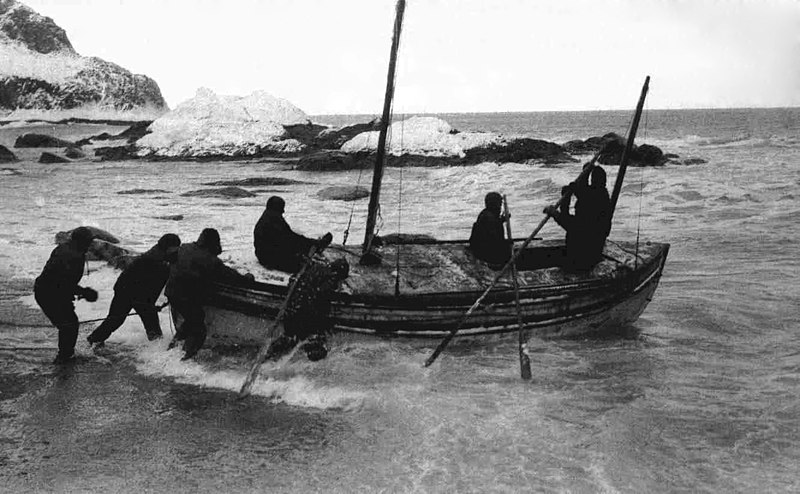
South Georgia was 800 miles (!) away, across one of the stormiest seas in the world at that time of year. Shackleton and his men managed to cross it in an open lifeboat, over 16 days of storms, cold, and thirst. Unfortunately, when they finally landed on South Georgia, they were on the wrong side of the island. So Shackleton and two of his men climbed over the island’s mountains and glaciers (a feat no one had yet achieved), with no sleeping bags or tent, through a day, a night, and the following day. On May 16, they reached the whaling station and, the next day, headed back in a whaling ship. They picked up the other three men on the far side of the island and headed south, but were turned back by pack ice. Two more failed attempts were made until finally, on August 30, 1916, Shackleton was reunited with his men on Elephant Island.

This story is just incredible. And the most incredible thing is that, in all that time, and through all that hardship, not one man was lost. (Frostbitten toes were, however.)

Check out this map of Shackleton’s voyage (beginning and ending in South Georgia), and marvel at this amazing accomplishment:

When Shackleton finally returned to England, any celebration of his achievement was muted by the fact that England was embroiled in World War I, and thousands of men were dying by the day. The great yawning brutal abyss of Antarctica, and its shivery challenges, and the heroic battles Shackleton and his men waged to stay alive, all were dwarfed by the horrors that humans back home managed to inflict upon each other.

The Heart of the Great Alone: Scott

108 years ago:

“Had we lived, I should have had a tale to tell of the hardihood, endurance, and courage of my companions which would have stirred the heart of every Englishman. These rough notes and our dead bodies must tell the tale, but surely, surely, a great rich country like ours will see that those who are dependent on us are properly provided for.” — Robert Falcon Scott, late March, 1912

These are words whose power continues to ring down through the years, lending Scott’s second (and fatal) Antarctic expedition perhaps a more weighty awe than if he had survived. What a moment it must be, to look your death in the eye, and in putting pen to paper, write from a future about your own passing. (“Had we lived…”)

I had the great fortune to visit “The Heart of the Great Alone” at the Queen’s Gallery in Edinburgh, Scotland. This is an exhibition of photographs taken by photographers that accompanied Scott and Shackleton on their Antarctic journeys. Herbert George Ponting traveled with Scott to his base camp in McMurdo Sound, where the crew spent an Antarctic winter before Scott set out for the South Pole in the spring. During this time, Ponting took many beautiful and breathtaking photographs of the sea, the ice, the ship, and the wildlife, and as I moved through the gallery, I marveled at the quality of the photographs. They were taken on glass plates and had to have been a terrible burden to drag around. He developed them himself in the base camp hut, using chemicals he’d brought along. All of the photos have a marvelous depth of light and even color. The dynamic range that Ponting captured, of both sunlit ice and shadowed grottoes, is incredible. He also had a gift for composition.

Scott, on the other hand, was unlucky and (it seems) also not entirely well prepared for his South Pole mission. Roald Amundsen had landed closer in to the Pole, and set out on his own expedition two weeks before Scott did. Amundsen had better experience and had chosen his equipment more carefully, relying on sled dogs for both transport and (intentionally) food. Scott had some dogs but did not know how to best use them. He felt that it was most honorable to attempt the Pole by “man-hauling” everything instead. It is heartbreaking to read bits of his diary from when they finally made it to the Pole, only to learn that Amundsen had reached it five weeks earlier; and even more terrible to read about the despondent, doomed attempt to return to McMurdo Sound (~850 miles). In fact, three of the five men made it to within 11 miles of their final pre-laid depot of food and fuel, near 80 degrees south, but a bad storm trapped Scott and his two companions in their tent, where they starved.

The photographer, Ponting, did not accompany them on the Pole trek, but did train them in the use of a camera. The photo at left was taken at the Pole soon after discovering the tent and markers Amundsen had left behind. The Pole party’s photos have a much grittier feel to them than the ones Ponting took. Maybe they had a lower-quality, more portable camera, or maybe they weren’t as experienced at working the camera settings. But the power of all of these photographs, no matter who took them, printed large and displayed in a gallery, is hard to convey. As I looked at them, it hit me that the only reason we have these final photos is that the negatives must have been carefully carried along by Scott and his men, and then later discovered in the tent where they died.

[As a side note of curiosity, I wondered how Scott and Amundsen navigated, to determine when they had reached the South Pole. They knew in advance that it was not the same as the magnetic South Pole, so compasses wouldn’t tell them where it was. It turns out that they used solar measurements to determine their longitude (so as to maintain a straight south bearing) and (as best as I can determine) used this to determine how much their compasses had to be “corrected” to point to the true South Pole. That sounds like a fascinating bit of history I’d like to know more about!]

Scott left behind a wife and a two-year-old son. These are the dependents to which he referred in his final hours. No doubt much anxiety and despair accompanied the writing of those words. I’m left to marvel at the mind and the will possessed by those who engaged in these formidably risky, all-nigh incredible expeditions, with primitive gear and little understanding of the environment or their destination. We later generations stand in debt to their hardiness and determination in exploring the last frontier continent.

« Newer entries · Older entries »