2025
- Papers
-
Realistic Handwritten Multi-Digit Writer (MDW) Number
Recognition Challenges.
Kiri L. Wagstaff.
arXiv:2512.00676, 2025.- We created three benchmark data sets for the challenging task of recognizing multi-digit handwritten numbers. These include U.S. ZIP Codes, handwritten check amounts, and clock times. Each number is assembled from single-digit examples written by the same human writer. We hope these data sets can inspire the development of methods that can leverage task-specific knowledge to improve performance well beyond that of individual digit classification methods.
- Download the MDW Benchmark Data Sets
- Visit the MDW-handwritten code repository
-
New Impacts on Mars: Systematic Identification and
Association With InSight Seismic Events.
Valentin T. Bickel, Ingrid J. Daubar, Géraldine Zenhäusern, Gary Doran, Constantinos Charalambous, Ben Fernando, Aleksandra Sokolowska, Kiri L. Wagstaff, Tom Pike, Simon C. Stähler, John Clinton, and Domenico Giardini.
Geophysical Research Letters, 52(3), e2024GL109133, 2025.- We used machine learning to find visually fresh impact craters on Mars and localize them in space, plus data from the InSight lander's seismometer to pinpoint impacts in time. Correlating the two helps us estimate typical impact rates in this area. So far, we have found 49 seismic events that match a visual impact feature.
- JPL press release: NASA's InSight Finds Marsquakes From Meteoroids Go Deeper Than Expected
-
Realistic Handwritten Multi-Digit Writer (MDW) Number
Recognition Challenges.
2024
- Papers
-
Interactive Mars Image Content Classification with
Interpretable ML.
Bhavan Vasu, Steven Lu, Emily Dunkel, Kiri L. Wagstaff, Kevin Grimes, and Michael McAuley.
Proceedings of the Thirty-Sixth Annual Conference on Innovative Applications of Artificial Intelligence, 38(21), 22976-22982, DOI 10.1609/aaai.v38i21.30338, 2024. - Machine Learning for Healthcare that Matters: Reorienting
from Technical Novelty to Equitable Impact.
Aparna Balagopalan, Ioana Baldini, Leo Anthony Celi, Judy Gichoya, Liam G. McCoy, Tristan Naumann, Uri Shalit, Mihaela van der Schaar, and Kiri L. Wagstaff.
PLOS Digital Health, DOI 10.1371/journal.pdig.0000474, 2024.- A compendium of obstacles and Ideas for how to move from doing machine learning _on_ healthcare data to using machine learning _for_ healthcare, to achieve real impact.
-
Interactive Mars Image Content Classification with
Interpretable ML.
- Abstracts
-
GOTCHA! Machine-Learning Assisted Mapping & Correlation
of Co-InSight Impacts on Mars.
V. T. Bickel, I. J. Daubar, G. Zenhäusern, S. Stähler, G. Doran, K. Wagstaff, A. Sokolowska, P. Grindrod, C. Charalambous, B. Fernando, and D. Giardini.
55th Lunar and Planetary Science Conference, Abstract #2323, March 2024. -
New Impacts around the InSight Lander – Chapter 1: Orbital
Mapping and Initial Seismic Correlation.
V. T. Bickel, I. J. Daubar, G. Zenhäusern, G. Doran, C. Charalambous, B. Fernando, A. Sokolowska, K. L. Wagstaff, T. Pike, S. C. Stähler, J. Clinton, and D. Giardini.
Mars Interior and Geophysics after InSight 2024, Abstract #6026, July 2024.
-
GOTCHA! Machine-Learning Assisted Mapping & Correlation
of Co-InSight Impacts on Mars.
2023
- Papers
-
Hidden Heterogeneity: When to Choose Similarity-Based Calibration.
Kiri L. Wagstaff and Thomas G. Dietterich.
Transactions on Machine Learning Research, 2023.- We developed a method to calibrate classification predictions by leveraging similarity in feature space. This approach can particularly benefit subpopulations within the data set.
-
Cosmic Microwave Background Recovery: A Graph-Based Bayesian Convolutional Network Approach.
Jadie Adams, Steven Lu, Krzysztof M. Gorski, Graça Rocha, and Kiri L. Wagstaff.
Proceedings of the Thirty-Fifth Annual Conference on Innovative Applications of Artificial Intelligence, 37(13), 15640-15646, DOI 10.1609/aaai.v37i13.26854, 2023.
-
Hidden Heterogeneity: When to Choose Similarity-Based Calibration.
- Abstracts
-
Characterizing False Positives in CRISM VNIR Frost
Detections.
Pranav Rupireddy, Gary Doran, Christina E. Viviano, Serina Diniega, Kiri L. Wagstaff, Samuel F. A. Cartwright, Katie Hancock, Frank P. Seelos, Kimberley D. Seelos, and Jake M. Widmer.
6th Planetary Data Workshop, Abstract #7051, June 2023.
-
Characterizing False Positives in CRISM VNIR Frost
Detections.
2022
- Papers
-
Domain-Agnostic Outlier Ranking Algorithms - A Configurable Pipeline for Facilitating Outlier Detection in Scientific Datasets.
Hannah R. Kerner, Umaa Rebbapragada, Kiri L. Wagstaff, Steven Lu, Bryce Dubayah, Eric Huff, Jake Lee, Vinay Raman, and Sakshum Kulshrestha.
Frontiers in Astronomy and Space Sciences, DOI 10.3389/fspas.2022.867947, 2022. -
Resource Consumption and Radiation Tolerance Assessment for Data Analysis Algorithms Onboard Spacecraft.
Gary Doran, Ameya Daigavane, and Kiri Wagstaff.
IEEE Transactions on Aerospace and Electronic Systems, vol. 58(6), p. 5180-5189, DOI 10.1109/TAES.2022.3169123, 2022. -
Tutorial: How to Access, Process, and Label PDS Image Data
for Machine Learning.
Steven Lu, Kiri Wagstaff, Rafael Alanis, Gary Doran, Kevin Grimes, and Jordan Padams.
Chapter in Machine Learning for Planetary Science, 2022. -
Unsupervised Detection of Saturn Magnetic Field Boundary
Crossings From Plasma Spectrometer Data.
Ameya Daigavane, Kiri L. Wagstaff, Gary Doran, Corey Cochrane, Caitriona M. Jackman, and Abigail Rymer.
Computers & Geosciences, vol. 161, DOI 10.1016/j.cageo.2022.105040, 2022. -
Using Machine Learning to Reduce Observational Biases when
Detecting New Impacts on Mars.
Kiri L. Wagstaff, Ingrid J. Daubar, Gary Doran, Michael J. Munje, Valentin T. Bickel, Annabelle Gao, Joe Pate, and Daniel Wexler.
Icarus, vol. 386, DOI 10.1016/j.icarus.2022.115146, 2022.- We applied a convolutional neural network to 13 years of CTX orbital images of Mars and found ~70 new fresh impacts, plus a large number of additional candidates that can help us reduce observational bias in the catalog of known impacts.
- CTX data set (labeled Mars orbiter images):

- Wired article
-
New Craters on Mars: An Updated Catalog.
Ingrid J. Daubar, Colin M. Dundas, Alfred S. McEwen, Annabelle Gao, Daniel Wexler, Sylvain Piqueux, G. S. Collins, K. Miljkovic, T. Neidhart, J. Eschenfelder, G. D. Bart, Kiri Wagstaff, Gary Doran, L. Posiolova, M. Malin, G. Speth, D. Susko, and A. Werynski.
Journal of Geophysical Research: Planets, DOI 10.1029/2021JE007145, 2022. -
Evaluating Terrain-Dependent Performance for Martian Frost Detection in Visible Satellite Observations.
Gary Doran, Serina Diniega, Steven Lu, Mark Wronkiewicz, Kiri L. Wagstaff, and Jacob Widmer.
Proceedings of the Third ACM SIGKDD Workshop on Deep Learning for Spatiotemporal Data, Applications, and Systems (DeepSpatial), 2022. - Exploiting Unary Relations with Stacked Learning for Relation Extraction.
Yuan Zhuang, Ellen Riloff, Kiri L. Wagstaff, Raymond Francis, Matthew P. Golombek, and Leslie K. Tamppari, COLING Third Workshop on Scholarly Document Processing, 2022.
-
Domain-Agnostic Outlier Ranking Algorithms - A Configurable Pipeline for Facilitating Outlier Detection in Scientific Datasets.
- Abstracts and Posters
-
Targets from the Spirit Mars Exploration Rover in the
Mars Target Encyclopedia.
(Poster)
Kiri L. Wagstaff, Raymond Francis, Matthew Golombek, Steven Lu, Ellen Riloff, Leslie Tamppari, Yuan Zhuang, and Thomas Stein.
53rd Lunar and Planetary Science Conference, Abstract #1231, March 2022.- What's in twenty years / Of talk about Mars targets? / Olivine and more!
- The MTE database is available at the PDS: Mars Target Encyclopedia
-
Geostatistical Analysis of all RSL within Rauna crater to
Distinguish Between RSL Formation Mechanisms.
David E. Stillman, Katie M. Primm, Brian Bue, Kiri L. Wagstaff, Jake H. Lee, and Adnan Ansar.
53rd Lunar and Planetary Science Conference, Abstract #1419, March 2022. -
New Craters on Mars: Results from a Complete Catalog of
1,203 Recent Impacts.
Ingrid J. Daubar, Colin Dundas, Alfred S. McEwen, Annabelle Gao, Daniel Wexler, Sylvain Piqueux, G. S. Collins, K. Miljkovic, T. Neidhart, J. Eschenfelder, G. D. Bart, Kiri Wagstaff, Gary Doran, L. Posiolova, G. Speth, D. Susko, A. Werynski, and Michael Malin.
53rd Lunar and Planetary Science Conference, Abstract #1590, March 2022. -
The PDS Discipline Namespace for Machine Learning
Products.
Kiri L. Wagstaff, Michael McAuley, and Minh Le.
Planetary Science Informatics and Data Analytics Conference, June 2022. -
Building Machine-Learning-Ready Data Sets for Martian Frost
Detection.
Gary Doran, Serina Diniega, Kiri L. Wagstaff, Mark Wronkiewicz, Steven Lu, and Jake Widmer.
Planetary Science Informatics and Data Analytics Conference, June 2022. -
Deep Ensemble MERNet: Recent Advances for the Content-Based
Classification of MER Pancam Images.
Steven Lu, Kiri L. Wagstaff, Kevin Grimes, and Maxwell Plotkin.
Planetary Science Informatics and Data Analytics Conference, June 2022.- Browse classifications of images from the Mars Exploration Rovers
-
In-situ Science Data Analysis and Curation for the Europa
Lander Autonomous Mission Prototype.
Yuliya Marchetti, Caleb Wagner, Philip Twu, Marissa Cameron, Glenn Reeves, Grace Tan-Wang, Steve Chien, Rebecca Castano, and Kiri Wagstaff.
Planetary Science Informatics and Data Analytics Conference, June 2022. -
Geomorphological Differences in Slope Streaks and RSL.
David Stillman, Katie Primm, Rachael Hoover, Brian Bue, Tim Michaels, Hannah Kaplan, Kiri Wagstaff, Jake Lee, Adnan Ansar, and Lori Fenton.
Geological Society of America, October 2022. -
Mapping Martian Frost over Multiple Scales, Based on Visible
and Thermal Frost Detections.
Serina Diniega, Gary Doran, Steven Lu, Kiri Wagstaff, Mark Wronkiewicz, Jacob Widmer, and Pranav Rupireddy.
54th Annual Meeting of the AAS Division of Planetary Science, October 2022. -
Content-Based Search of Large Image Archives at the PDS Imaging Node.
Steven Lu, Kiri L. Wagstaff, Emily Dunkel, Bhavan Vasu, Kevin Grimes, and Michael McAuley.
Fall Meeting of the American Geophysical Union, December 2022.- Browse classifications of images from the MSL rover, the HiRISE instrument on the MRO orbiter, or the Mars Exploration Rovers
- LROCNet: Detecting Impact Ejecta and Older Craters on the Lunar Surface.
(poster,
content)
Emily Dunkel, Steven Lu, Kevin Grimes, James McAuley, and Kiri Wagstaff.
Fall Meeting of the American Geophysical Union, December 2022. -
Machine Learning is its Own Language: A Common Tool for the ML Community.
Sara Bond, Kiri Wagstaff, and James McAuley.
Fall Meeting of the American Geophysical Union, December 2022.
-
Targets from the Spirit Mars Exploration Rover in the
Mars Target Encyclopedia.
(Poster)


2021
- Papers
-
Mars Image Content Classification: Three Years of NASA
Deployment and Recent Advances
(IAAI Deployed Application Award).
Kiri Wagstaff, Steven Lu, Emily Dunkel, Kevin Grimes, Brandon Zhao, Jesse Cai, Shoshanna B. Cole, Gary Doran, Raymond Francis, Jake Lee, and Lukas Mandrake.
Proceedings of the Thirty-Third Annual Conference on Innovative Applications of Artificial Intelligence, p. 15204-15213, 2021.- We report on updates to Mars image classifiers deployed at the NASA Planetary Data System, for orbital and rover images, and lessons learned that inform ongoing activities to build new classifiers for additional missions.
- HiRISE data set (labeled Mars orbiter images, V3.2):

- MSL data set (labeled Mars rover images, V2):

- Browse classifications of images from the MSL rover, the HiRISE instrument on the MRO orbiter, or the Mars Exploration Rovers
- Integrating
Novelty Detection Capabilities with MSL Mastcam Operations
to Enhance Data Analysis.
Paul Horton, Hannah R. Kerner, Samantha Jacob, Ernest Cisneros, Kiri L. Wagstaff, and James Bell.
Proceedings of the IEEE Aerospace Conference, 2021.
-
Mars Image Content Classification: Three Years of NASA
Deployment and Recent Advances
- Abstracts and Posters
-
Designing a Machine Learning Local Data Dictionary.
(Poster)
Minh Le, Michael McAuley, and Kiri Wagstaff.
5th Planetary Data Workshop and Planetary Science Informatics and Data Analytics (PSIDA) Meeting, Abstract #7085, July 2021. -
The Mars Target Encyclopedia Now Includes Mars Pathfinder
and Mars Phoenix Targets.
(Poster)
Kiri L. Wagstaff, Raymond Francis, Matthew Golombek, Steven Lu, Ellen Riloff, Leslie Tamppari, and Thomas C. Stein.
52nd Lunar and Planetary Science Conference, Abstract #1278, March 2021.- What about Yogi? / Mars mission targets abound / You can find them here
- The MTE database is now available at the PDS: Mars Target Encyclopedia
-
Content-Based Classification of Mars Exploration Rover
Pancam Images.
(Poster)
Steven Lu, Brandon Zhao, Kiri L. Wagstaff, Shoshanna B. Cole, and Kevin Grimes.
52nd Lunar and Planetary Science Conference, Abstract #1779, March 2021. -
Novelty-Driven Onboard Target Selection in Grayscale and
Color Mars Rover Images.
(Poster)
Hannah R. Kerner, Kiri L. Wagstaff, Steven Lu, Raymond Francis, and Sakshum Kulshrestha.
52nd Lunar and Planetary Science Conference, Abstract #2618, March 2021.- Rovers are searching / Color images reveal / Novel rocks and veins
-
RSL Geostatistics Show Slopes Above the Angle of Repose
and Significant Enhancement After Mars Year 34 Dust
Storm.
(Poster)
David E. Stillman, Katie M. Primm, Brian Bue, Kiri L. Wagstaff, Jake H. Lee, and Adnan Ansar.
52nd Lunar and Planetary Science Conference, Abstract #1578, March 2021.- RSL are steep / Increased after the dust storm / Unique dry formation?
-
Using Machine Learning to Complement New Martian Crater
Inventories.
(Poster)
Annabelle Gao, Ingrid J. Daubar, Daniel Wexler, Kiri L. Wagstaff, Valentin Bickel, and Gary Doran.
52nd Lunar and Planetary Science Conference, Abstract #1674, March 2021.- Machine learning finds / Fresh impacts on Mars that we / Missed before, what now?
- Benchmarking Machine Learning on the Myriad X Processor
Onboard the ISS.
Emily Dunkel, José Luis Espinosa-Aranda, Juan Romero Cañas, Léonie Buckley, Zaid Towfic, Faiz Mirza, Jason Swope, Damon Russell, Joseph Sauvageau, Douglas Sheldon, Steve Chien, Mark Fernandez, Carrie Knox, Kiri Wagstaff, Steven Lu, Michael Denbina, Deegan Atha, Michael Swan, and Hiro Ono.
International Space Station Research and Development Conference, August 2021. -
Domain-agnostic Outlier Ranking Algorithms (DORA): An
API for Outlier Detection in Scientific Datasets.
Hannah Kerner, Kiri Wagstaff, Steven Lu, Umaa Rebbapragada, Eric Huff, Bryce Dubayah, Vinay Raman, and Sakshum Kulshrestha.
Fall Meeting of the American Geophysical Union, December 2021.
-
Designing a Machine Learning Local Data Dictionary.
(Poster)
2020
- Papers
-
Novelty-Driven Onboard Targeting for Mars Rovers.
Kiri L. Wagstaff, Raymond Francis, Hannah Kerner, Steven Lu, Favour Nerrise, James F. Bell III, Gary Doran, and Umaa Rebbapragada.
Proceedings of the International Symposium on Artificial Intelligence, Robotics and Automation in Space, 2020. -
Detection of Environment Transitions in Time Series Data for Responsive Science.
Ameya Daigavane, Kiri Wagstaff, Gary Doran, Corey Cochrane, Caitriona Jackman, and Abigail Rymer.
6th KDD Workshop on Mining and Learning for Time Series, 2020. -
Efficient Active Learning in New Domains.
Kiri Wagstaff and Steven Lu.
ICML Workshop on Real World Experiment Design and Active Learning, 2020.- How can we train classifiers when we don't know what all possible classes are before we begin? To support discovery in exploration settings, we employ active learning to help with discovering classes and labeing data. We apply this approach to a Mars rover data set.
- Data set (labeled Mars rover images):

- Visualizing Image Content to Explain Novel Image Discovery
(free view-only access to full text).
Jake H. Lee and Kiri L. Wagstaff.
Data Mining and Knowledge Discovery, 34(6), p. 1777-1804, DOI 10.1007/s10618-020-00700-0, 2020.- We combine novelty detection with CNN image features to achieve rapid discovery with interpretable explanations of novel image content. We also report on a user study of explanation utility.
- Visit the paper website for code, data, etc.
-
Comparison of Novelty Detection Methods for Multispectral Images
in Rover-based Planetary Exploration Missions.
Hannah R. Kerner, Kiri L. Wagstaff, Brian D. Bue, Danika F. Wellington, Samantha Jacob, Paul Horton, James F. Bell III, Chiman Kwan, and Heni Ben Amor.
Data Mining and Knowledge Discovery, vol. 34(6), p. 1652-1675, DOI 10.1007/s10618-020-00697-6, 2020.- We compare multiple novelty detection methods on multispectral (6-channel) images collected by a Mars rover. We find that some methods are more sensitive to spectral (compositional) novelty, while others are more sensitive to morphological (shape-based) novelty.
- Code: Novelty Detection in Multispectral Mastcam Images (github)
- Data: Mars novelty detection Mastcam labeled dataset

-
COSMIC: Content-based Onboard Summarization to Monitor Infrequent Change.
Gary Doran, Steven Lu, Maria Liukis, Lukas Mandrake, Umaa Rebbapragada, Kiri L. Wagstaff, Jimmie Young, Erik Langert, Anneliese Braunegg, Paul Horton, Daniel Jeong, and Asher Trockman.
Proceedings of the IEEE Aerospace Conference, 2020. -
ARIEL: Autonomous Excavation Site Selection for Europa Lander Mission Concept.
Masahiro Ono, Gary Doran, Erik Langert, Kiri Wagstaff, David Inkyu Kim, Aaron Gaut, Tara Estlin, Abhi Jain, Marissa Cameron, David Muliere, Erik Roberts, Kristopher Kriechbaum, and Glenn Reeves.
Proceedings of the IEEE Aerospace Conference, 2020. -
Evaluation of wet and dry Recurring Slope Lineae (RSL)
formation mechanisms based on quantitative mapping of RSL in
Garni Crater, Valles Marineris, Mars.
David E. Stillman, Brian D. Bue, Kiri L. Wagstaff, Katherine M. Primm, Tim I. Michaels, and Robert E. Grimm.
Icarus, vol. 335, 2020.
-
Novelty-Driven Onboard Targeting for Mars Rovers.
- Abstracts and Posters
- Machine-Assisted Discovery Through Identification and
Explanation of Anomalies in Astronomical Surveys.
Kiri L. Wagstaff, Eric Huff, and Umaa Rebbapragada.
Astronomical Data Analysis Software and Systems Conference, 2020. -
Evaluation of Machine Learning Methodologies for Novelty-based Target Selection in Planetary Imaging Data Sets: Examples from the Mars Science Laboratory Mission.
Favour Nerrise, Hannah Rae Kerner, Kiri Wagstaff, Steven Lu, Raymond Francis, Umaa Rebbapragada, and James F. Bell III.
Fall Meeting of the American Geophysical Union, December 2020. -
Novelty and Discovery Content Analysis Methods for the Planetary Data System Image Atlas.
Paul Horton, Sanjna Ravichandar, Jake Lee, Hannah Rae Kerner, Anil Natha, Tariq K. Soliman, Kevin Grimes, Kiri Wagstaff, Rishi Verma, and Michael McAuley.
Fall Meeting of the American Geophysical Union, December 2020. -
Large-Scale Automated Detection of Fresh Impacts on Mars Using Machine Learning with CTX Observations.
Michael J. Munje, Ingrid J. Daubar, Gary Doran, Kiri Wagstaff, and Lukas Mandrake.
11th Planetary Crater Consortium, Abstract #2065, August 2020.- JPL press release about new discoveries: AI Is Helping Scientists Discover Fresh Craters on Mars
- Universe today: Machine Learning Software is Now Doing the Exhausting Task of Counting Craters On Mars
- CTX fresh impacts data set:

-
Assessing the Susceptibility of Europa Clipper Onboard
Thermal Anomaly Detection to Radiation.
G. Doran, K. L. Wagstaff, J. Bapst, A. G. Davies, and S. Anwar.
51st Lunar and Planetary Science Conference, Abstract #2193, March 2020. -
MER Contact Science Targets: Archived Database and Inclusion
in the Analyst's Notebook.
T. C. Stein, R. E. Arvidson, S. J. Van Bommel, K. L. Wagstaff, E. Riloff, F. Zhou, and E. A. Guinness.
51st Lunar and Planetary Science Conference, Abstract #1942, March 2020. - Time-Series Analysis Methods for On-board Detection of Magnetic Field Boundaries by Europa Clipper.
Ameya Daigavane, Kiri L. Wagstaff, Corey J. Cochrane, Caitriona M. Jackman, and Gary B. Doran, Jr.
Second AI and Data Science Workshop, March 2020. - Content-based Classification of Mars Imagery for the PDS Image Atlas.
Steven Lu and Kiri L. Wagstaff.
Second AI and Data Science Workshop, March 2020.
- Machine-Assisted Discovery Through Identification and
Explanation of Anomalies in Astronomical Surveys.
2019
- Papers
-
Toward Generalized Change Detection on Planetary Surfaces with Convolutional Autoencoders and Transfer Learning.
Hannah R. Kerner, Kiri L. Wagstaff, Brian D. Bue, Patrick C. Gray, James F. Bell III, and Heni Ben Amor.
Journal of Selected Topics in Applied Earth Observations and Remote Sensing, vol. 12, issue 10, p. 3900-3918, 2019. -
Enabling Onboard Detection of Events of Scientific Interest
for the Europa Clipper Spacecraft.
Kiri Wagstaff, Gary Doran, Ashley Davies, Saadat Anwar, Srija Chakraborty, Marissa Cameron, Ingrid Daubar, and Cynthia Phillips.
Proceedings of the 25th International Conference on Knowledge Discovery and Data Mining (KDD), p. 2191-2201, 2019.- We make a case for the utility of onboard analysis of data collected by Europa Clipper (future mission to Europa) to enable prioritization of data for downlink. We describe three onboard detection algorithms to address the science goals detecting thermal anomalies (hot spots), compositional anomalies, and active plumes. We also report lessons learned from developing and evaluating these methods in the context of an onboard computing environment and mission acceptance.
- Watch the 3-minute video
- Press coverage:
-
Toward Generalized Change Detection on Planetary Surfaces with Convolutional Autoencoders and Transfer Learning.
-
Moving Target Indication in Moderate Resolution, Passive MISR Satellite Imagery.
Michael J. Garay and Kiri L. Wagstaff.
International Geoscience and Remote Sensing Symposium, July 2019.- We detect sub-pixel moving vessels in ocean scenes as bright outliers in 14-bit observations. Multi-angle MISR observations cover a temporal span sufficient to also yield an estimate of vessel speed and direction of motion from a single observation.
- Novelty Detection for Multispectral Images with Application to Planetary Exploration.
Hannah R. Kerner, Danika F. Wellington, Kiri L. Wagstaff, James F. Bell, and Heni Ben Amor.
Proceedings of the 31st Annual Conference on Innovative Applications of Artificial Intelligence, p. 9484-9491, 2019.- We use an autoencoder to detect unusual image content, such as meteorites on the Martian surface, in multispectral images.
- Data set (labeled images):

- Content-based Classification of Mars Imagery for the PDS Image Atlas.
Steven Lu, Kiri Wagstaff, Jesse Cai, Gary B. Doran, Kevin Grimes, Jake Lee, and Lukas Mandrake.
Fall Meeting of the American Geophysical Union, December 2019. - Opportunities for Increased Data Return through Coordinated Instrument Observations on Europa Clipper.
Marissa Cameron, Kiri Wagstaff, Gary B. Doran, Ashley G. Davies, Ingrid Daubar, and Philip R. Christensen.
Fall Meeting of the American Geophysical Union, December 2019. - Toward Generalized Change Detection on Planetary Surfaces with Deep Learning.
Hannah R. Kerner, Kiri Wagstaff, Brian D. Bue, Patrick C. Gray, James F. Bell, and Heni Ben Amor.
Fall Meeting of the American Geophysical Union, December 2019. - UKIRT Microlensing Survey as a Pathfinder for WFIRST.
Geoff Bryden, Yossi Shvartzvald, Savannah Jacklin, Selina Chu, Kiri Wagstaff, Sebastiano Calchi Novati, C. Beichman, S. Gaudi, C. Henderson, S. Johnson, D. Nataf and M. Penny.
Extreme Solar Systems IV, August 2019. -
Quantitative Mapping and Evaluation of Wet and Dry Formation Mechanisms of Recurring Slope Lineae (RSL) in Garni Crater, Valles Marineris, Mars.
David E. Stillman, Brian D. Bue, Kiri L. Wagstaff, Katie M. Primm, and Robert E. Grimm.
Ninth International Conference on Mars, Abstract #6098, July 2019. -
Automatic Plume Detection for the Europa Imaging System.
Gary Doran, Kiri L. Wagstaff, Marissa Cameron, Ingrid Daubar, and Cynthia Phillips.
Fourth Planetary Data Workshop, Abstract #7026, June 2019.- We apply image analysis and adaptive thresholding methods to detect the target body's limb and determine whether there is evidence for an active plume. This technology could potentially be used to detect plumes in situ within images of Europa obtained by the Europa Imaging System (EIS) instrument on the upcoming Europa Clipper mission.
- Data set (labeled images with and without plumes):

-
Comparison of Novelty Detection Methods for Multispectral
Images from the Mastcam Instrument onboard Mars Science
Laboratory.
Hannah R. Kerner, Kiri L. Wagstaff, Brian Bue, Danika Wellington, Samantha Jacob, James F. Bell III, and Heni Ben Amor.
Fourth Planetary Data Workshop, Abstract #7115, June 2019.- We describe experiments with different novelty detection methods applied to rover images to aid in directing attention to the images most likely to be of interest to mission scientists and planners. These include images of meteorites, rock veins, broken rocks, and other surface features with unusual mineralogy. We found that a convolutional autoencoder had the best overall precision@N performance. However, individual classes showed different behavior, with a standard SVD yielding the best AUC for naturally occurring features (broken rocks, float rocks, and meteorites) and a generative adversarial network (GAN) yielding the best performance for novel features created by the rover itself (drill holes, brush spots, and dump piles).
-
Improved Content-Based Image Classifiers for the PDS Image Atlas.
Steven Lu, Kiri L. Wagstaff, Jesse Cai, Gary Doran, Kevin Grimes, Jake Lee, Lukas Mandrake, and Yisong Yue.
Fourth Planetary Data Workshop, Abstract #7028, June 2019.- We report on several improvements to the classifiers we developed to assign content labels to NASA images collected by Mars rovers and orbiters. The improvements include data augmentation, classifier calibration, and updates to the fine-tuning methodology.
- Data set (labeled HiRISE images, V3):

-
MSL Analyst's Notebook: Improved Connections between Targets,
Data, and Published Literature.
Thomas C. Stein, Raymond E. Arvidson, Kiri L. Wagstaff, and Feng Zhou.
Fourth Planetary Data Workshop, Abstract #7027, June 2019. -
Browsing the PDS Image Archive with the Imaging Atlas and Apache
Solr.
Kevin M. Grimes II, Jordan H. Padams, Alice Stanboli, and Kiri L. Wagstaff.
Fourth Planetary Data Workshop, Abstract #7093, June 2019. - Responsive Onboard Science for the Europa Clipper Mission.
Kiri Wagstaff, Gary Doran, Ashley Davies, Saadat Anwar, Srija Chakraborty, Diana Blaney, Marissa Cameron, Jonathan Bapst, Steve Chien, Corey Cochrane, Ingrid Daubar, Serina Diniega, Cynthia Phillips, and Sylvain Piqueux.
JPL Data Science Showcase, Poster 29, April 2019. - Optimizing WFIRST Exoplanet Yield using Machine Learning
for Microlensing Event Detection.
Selina Chu, Kiri L. Wagstaff, Geoffrey Bryden, Yossi Shvartzvald, and Savannah Jacklin.
JPL Data Science Showcase, Poster 64, April 2019. - Deep Mars: A CNN Approach that Enables Image Content-Based
Search for PDS Image Atlas.
Steven Lu, Kiri Wagstaff, Kevin Grimes, Gary Doran, Lukas Mandrake,
Jake Lee, and Jesse Cai.
JPL Data Science Showcase, Poster 35, April 2019. - Content-based Onboard Summarization to Monitor Infrequent
Change (COSMIC) - An Ultra-Low Bandwidth, Autonomous System
to Globally Monitor Mars for Dynamic Events.
Lukas Mandrake, Kiri Wagstaff, Gary Doran, Steven Lu, Erik Langert, and Jimmie Young.
JPL Data Science Showcase, Poster 14, April 2019. - An Anomaly Catalog for the Dark Energy Survey.
Umaa Rebbapragada, Eric Huff, and Kiri Wagstaff.
JPL Data Science Showcase, Poster 68, April 2019. -
Spectral Anomaly Detection for the Mapping Imaging Spectrometer for Europa (MISE).
Kiri L. Wagstaff, Diana L. Blaney, Srija Chakraborty, Steve A. Chien, Ashley G. Davies, Serina Diniega, and Gary Doran.
50th Lunar and Planetary Science Conference, Abstract #1604, March 2019.- We apply anomaly detection methods to NIMS observations of Europa and describe how they could be used onboard the upcoming Europa Clipper mission by the MISE instrument for in-situ detections. See also the poster.
-
MSL Analyst's Notebook: Curiosity APXS Concentration Data
Integration and Mars Target Encyclopedia and Interface Updates.
T. C. Stein, R. E. Arvidson, S. J. Van Bommel, K. L. Wagstaff, and F. Zhou.
50th Lunar and Planetary Science Conference, Abstract #1820, March 2019.
2018
- Papers
-
Interpretable Discovery in Large Image Data Sets.
Kiri L. Wagstaff and Jake Lee.
Proceedings of the ICML Workshop on Human Interpretability in Machine Learning (WHI), p. 107-113, 2018.- We combine novelty detection with CNN image features to achieve rapid discovery with interpretable explanations of novel image content.
- Visit the paper website for code, data, etc.
- Watch the 10-minute talk
- Automated Classification to Improve the Efficiency of Weeding Library Collections.
Kiri L. Wagstaff and Geoffrey Z. Liu.
Journal of Academic Librarianship, 44(2), p. 238-247, 2018.- We evaluated several machine learning classifiers in terms of their ability to predict which books are most likely to be weeded from a collection. We applied this method to a collection of more than 80,000 items from an academic library and found statistically significant agreement (p = 0.001) between classifier and librarian decisions.
-
Mars Target Encyclopedia: Rock and Soil Composition Extracted from the Literature.
Kiri L. Wagstaff, Raymond Francis, Thamme Gowda, You Lu, Ellen Riloff, Karanjeet Singh, and Nina L. Lanza.
Proceedings of the Thirtieth Annual Conference on Innovative Applications of Artificial Intelligence, p. 7861-7866, 2018.- Data set (annotated documents):

- Data set (annotated documents):
-
Deep Mars: CNN Classification of Mars Imagery for the PDS Imaging Atlas.
Kiri L. Wagstaff, You Lu, Alice Stanboli, Kevin Grimes, Thamme Gowda, and Jordan Padams.
Proceedings of the Thirtieth Annual Conference on Innovative Applications of Artificial Intelligence, p. 7867-7872, 2018.- Data set (labeled HiRISE images, V1):

- Data set (labeled Mars rover images):

- Data set (labeled HiRISE images, V1):
-
Interpretable Discovery in Large Image Data Sets.
- Abstracts and Posters
-
Novelty Detection for Multispectral Planetary Images.
Hannah Rae Kerner, Danika F. Wellington, Kiri Wagstaff, Samantha Jacob, James F. Bell III, and Heni Ben Amor.
Fall Meeting of the American Geophysical Union, Abstract #IN14A-01, December 2018. -
Automatic Detection of Microlensing Events in the Galactic Bulge
using Machine Learning Techniques.
Selina Chu, Kiri L. Wagstaff, Geoffrey Bryden, and Yossi Shvartzvald.
28th Astronomical Data Analysis Software & Systems (ADASS) Conference, Abstract #P1.21, November 2018. -
Responsive Onboard Science for Europa Clipper.
Kiri L. Wagstaff, Ashley Davies, Gary Doran, Srija Chakraborty, Saadat Anwar, Diana L. Blaney, Steve Chien, Philip R. Christensen, and Serina Diniega.
Outer Planets Assessment Group meeting, September 2018. -
Onboard Detection of Thermal Anomalies for Europa Clipper.
Gary Doran, Ashley G. Davies, Kiri L. Wagstaff, Saadat Anwar, Diana L. Blaney, Steve Chien, Phil Christensen, and Serina Diniega.
European Planetary Science Congress, Abstract #528, September 2018. -
PDS Analyst's Notebook: Curiosity ChemCam RMI Mosaic and Mars Target Encyclopedia Integration and Interface Updates.
T. C. Stein, R. E. Arvidson, W. Rapin, K. L. Wagstaff, D. Delapp, R. C. Wiens, O. Gasnault.
49th Lunar and Planetary Science Conference, Abstract #1248, March 2018.
-
Novelty Detection for Multispectral Planetary Images.
2017
- Thesis
-
Automated Classification to Improve the Efficiency of Weeding Library Collections.
Kiri L. Wagstaff. Master's Thesis (Library and Information Science), San Jose State University, 2017.
-
Automated Classification to Improve the Efficiency of Weeding Library Collections.
- Papers
-
Teaching Computers to Read About Mars.
Kiri L. Wagstaff.
Juniata Voices, vol. 18, 2017. -
Cloud Filtering and Novelty Detection using Onboard Machine Learning for the EO-1 Spacecraft.
Kiri L. Wagstaff, Alphan Altinok, Steve Chien, Umaa Rebbapragada, Steve Schaffer, David R. Thompson, and Daniel Tran.
IJCAI 2017 Workshop on AI in the Oceans and Space, 2017. -
Scientist-Guided Autonomy for Self-Reliant Rovers.
Gary Doran, Umaa Rebbapragada, Eugenie Song, Kiri Wagstaff, Daniel Gaines, Robert Anderson, and Ashwin Vasavada.
IJCAI 2017 Workshop on AI in the Oceans and Space, 2017. -
Robotic Space Exploration Agents.
Steve Chien and Kiri L. Wagstaff.
Science Robotics, 2(7), eaan4831, 2017.
- This paper received a lot of press coverage:
- A.I. Will Prepare Robots for the Unknown (JPL Press Release)
- JPL scientists predict future space probes will have artificial intelligence to operate autonomously (Phys.org)
- Space Robots Will Work for Decades in Alpha Centauri Before Humans (Inverse)
- Why the next space explorers could be autonomous robots (Sacramento Bee)
- NASA? More like NASAI: Brainy robots 'crucial' to space exploration (The Register)
- This paper received a lot of press coverage:
-
Onboard Autonomy on the Intelligent Payload EXperiment CubeSat Mission.
Steve Chien, Joshua Doubleday, David R. Thompson, Kiri L. Wagstaff, John Bellardo, Craig Francis, Eric Baumgarten, Austin Williams, Edmund Yee, Eric Stanton, and Jordi Piug-Suari.
Journal of Aerospace Information Systems, vol. 14, no. 6, p. 307-315, 2017. -
Marginalia in the Digital Age: Are Digital Reading Devices
Meeting the Needs of Today's Readers?
Melanie Ramdarshan Bold and Kiri L. Wagstaff.
Library & Information Science Research, 39(1), 16-22, 2017.- We surveyed readers to find out about their attitudes toward marginalia, and whether and how often they indulged in it themselves. We also investigated whether marginalia translates into electronic books and which features are most desired by users of e-readers.
-
Teaching Computers to Read About Mars.
- Abstracts and Posters
-
Recurring Slope Lineae (RSL) Observations Suggest Widespread Occurrence and Complex Behavior.
David E. Stillman, Robert E. Grimm, Kiri L. Wagstaff, Brian D. Bue, Timothy I. Michaels.
Fall Meeting of the American Geophysical Union, December 2017. -
Automated Mapping and Characterization of RSL from HiRISE data with MAARSL.
Brian D. Bue, Kiri L. Wagstaff, David E. Stillman.
49th Annual Meeting of the Division for Planetary Sciences, October 2017. -
Mars Target Encyclopedia: Information Extraction for Planetary Science.
Kiri L. Wagstaff, Raymond Francis, Thamme Gowda, You Lu, Ellen Riloff, and Karanjeet Singh.
Third Planetary Data Workshop, Abstract #7031, June 2017. -
Automated Content Detection for Cassini Images.
Alice Stanboli, Brian Bue, Kiri Wagstaff, and Alphan Altinok.
Third Planetary Data Workshop, Abstract #7048, June 2017. -
Observations and Updated Water Budget of Recurring Slope Lineae (RSL) in Garni Crater.
David E. Stillman, Brian D. Bue, Kiri L. Wagstaff, T. I. Michaels, and R. E. Grimm.
48th Lunar and Planetary Science Conference, Abstract #2506, March 2017.
-
Recurring Slope Lineae (RSL) Observations Suggest Widespread Occurrence and Complex Behavior.
2016
- Papers
-
Limits on Fast Radio Bursts from Four Years of the V-FASTR Experiment.
Sarah Burke-Spolaor, Cathryn M. Trott, Walter F. Brisken, Adam T. Deller, Walid A. Majid, Divya Palaniswamy, David R. Thompson, Steven J. Tingay, Kiri L. Wagstaff, and Randall B. Wayth.
The Astrophysical Journal, 826(2), doi:10.3847/0004-637X/826/2/223, 2016. -
A Machine Learning Classifier for Fast Radio Burst Detection at the VLBA.
Kiri L. Wagstaff, Benyang Tang, David R. Thompson, Shakeh Khudikyan, Jane Wyngaard, Adam T. Deller, Divya Palaniswamy, Steven J. Tingay, and Randall B. Wayth.
Publications of the Astronomical Society of the Pacific, 128:966(084503), 2016.- We describe the classifier used to filter VLBA fast radio burst detections to reduce the human effort needed to review and classify them manually. We also describe the web interface used for ongoing reviewing, which you can see for yourself at the V-FASTR Data Portal. You can also view the latest classifier results (updated daily).
-
Creating a Mars Target Encyclopedia by Extracting Information from the Planetary Science Literature (pdf, 5 pages, 421K)
[Slides (pptx, 5.4M)].
Kiri L. Wagstaff, Ellen Riloff, Nina L. Lanza, Chris A. Mattmann, and Paul M. Ramirez.
AAAI-16 Workshop on Workshop on Knowledge Extraction from Text, Feb. 2016.- We share the motivation for a Mars Target Encyclopedia and provide initial results from hand-annotation of planetary science papers.
-
Limits on Fast Radio Bursts from Four Years of the V-FASTR Experiment.
- Abstracts and Posters
-
Instrument Science Autonomy for Orbital and Flyby Planetary Missions.
Kiri L. Wagstaff, Alphan Altinok, Brian Bue, Steve A. Chien, and Lukas Mandrake.
Proceedings of the Third International Workshop on Instrumentation for Planetary Missions, October 2016. -
Instrument Autonomy Techniques Enhance Science Return and Efficiency of Surface Missions.
Raymond Francis, Tara A Estlin, Kiri L. Wagstaff, Gary Doran, and Lukas Mandrake.
Proceedings of the Third International Workshop on Instrumentation for Planetary Missions, October 2016. - NASA Tech Brief on V-FASTR Radio Transient Classifier, May 2016.
-
Instrument Science Autonomy for Orbital and Flyby Planetary Missions.
2015
- Papers
-
Onboard Machine Learning Classification of Images by a Cubesat in
Earth Orbit.
David R. Thompson, Alphan Altinok, Ben Bornstein, Steve A. Chien, Joshua Doubleday, John Bellardo, and Kiri L. Wagstaff.
AI Matters, 1(4), 38-40, 2015. -
Enhanced Flyby Science with Onboard Computer Vision: Tracking and Surface Feature Detection at Small Bodies.
Thomas Fuchs, David R. Thompson, Brian Bue, Julie Castillo, Steve Chien, Dero Gharibian, and Kiri Wagstaff.
Earth and Space Science, 2(10), 417-434, 2015. -
A Framework for Collaborative Review of Candidate Events in High Data Rate Streams: The V-FASTR Experiment as a Case Study.
Andrew F. Hart, Luca Cinquini, Shakeh E. Khudikyan, David R. Thompson, Chris A. Mattmann, Kiri Wagstaff, Joseph Lazio, and Dayton Jones.
Astronomical Journal, 149(1), 2015.
-
Onboard Machine Learning Classification of Images by a Cubesat in
Earth Orbit.
- Abstracts
- NASA Tech Brief on Discovery through Eigenbasis Modeling of Uninteresting Data, November 2015.
-
Landmark Classification and Content-Based Search for Mars Orbital Imagery.
Kiri L. Wagstaff, Gary B. Doran, Ravi Kiran, Lukas Mandrake, Norbert Schorghofer, and Alice Stanboli.
2nd Planetary Data Workshop, June 2015. -
Seasonal Water Budget Suggests that a Valles Marineris Recurring Slope Lineae (RSL) Site must be Recharged by an Aquifer.
David E. Stillman, Kiri L. Wagstaff, T. I. Michaels and R. E. Grimm.
46th Lunar and Planetary Science Conference, March 2015.
2014
- Papers
-
Astronomical Data Triage for Rapid Science Return.
Brian D. Bue, Kiri L. Wagstaff, Umaa D. Rebbapragada, David R. Thompson, and Benyang Tang.
Proceedings of the Big Data from Space Conference, 2014. -
Autonomous Real-time Detection of Plumes and Jets from Moons and
Comets.
Kiri L. Wagstaff, David R. Thompson, Brian D. Bue, and Thomas J. Fuchs.
The Astrophysical Journal, 794(1), doi:10.1088/0004-637X/794/1/43, 2014. -
Supporting Distributed, Collaborative Review and Classification of Fast Transient Events.
A. F. Hart, L. Cinquini, S. E. Khudikyan, D. R. Thompson, C. A. Mattmann, K. L. Wagstaff, J. Lazio, and D. Jones.
Computer, 47(9), 65-66, 2014. -
Real-Time Adaptive Event Detection in Astronomical Data Streams.
Randall B. Wayth, Kiri L. Wagstaff, Steven J. Tingay, Walid A. Majid, Divya Palaniswamy, Adam T. Deller, David R. Thompson, and Sarah Burke-Spolaor. IEEE Intelligent Systems, 29(1):48-55, 2014. -
Field Demonstration of an Instrument Performing Automatic Classification of Geologic Surfaces.
Dmitriy L. Bekker, David R. Thompson, William J. Abbey, Nathalie A. Cabrol, Raymond Francis, Ken S. Manatt, Kevin F. Ortega, and Kiri L. Wagstaff.
Astrobiology, 14(6), 486-501, 2014. -
Onboard Autonomy on the Intelligent Payload EXperiment (IPEX)
Cubesat Mission: A pathfinder for the proposed HyspIRI Mission
Intelligent Payload Module.
Steve Chien, Joshua Doubleday, David R. Thompson, Kiri L. Wagstaff, John Bellardo, Craig Francis, Eric Baumgarten, Austin Williams, Edmund Yee, Daniel Fluitt, Eric Stanton, and Jordi Piug-Suari.
Proceedings of the International Symposium on Artificial Intelligence, Robotics and Automation in Space, 2014. -
Autonomous Onboard Surface Feature Detection for Flyby Missions.
Thomas J. Fuchs, Brian D. Bue, Julie Castillo-Rogez, Kiri Wagstaff, David R. Thompson.
Proceedings of the International Symposium on Artificial Intelligence, Robotics and Automation in Space, 2014. - Agile Science: Using Onboard Autonomy for Primitive Bodies and Deep Space Exploration.
Steve Chien, Brian Bue, Julie Castillo-Rogez, Dero Gharibian, Russell Knight, Steve Schaffer, David R. Thompson, and Kiri L. Wagstaff.
Proceedings of the International Symposium on Artificial Intelligence, Robotics and Automation in Space, 2014. -
Machine Learning for Science and Society.
Cynthia Rudin and Kiri L. Wagstaff.
Machine Learning, 95(1), doi:10.1007/s10994-013-5425-9, 2014.- This is our introduction to the special issue of MLJ featuring papers that show how machine learning can benefit science investigations and problems of interest to society at large.
-
Astronomical Data Triage for Rapid Science Return.
- Abstracts and Posters
-
Big Data Tools Come to Mars: Content-Based Analysis of Mars Orbital Imagery.
Kiri L. Wagstaff, Ravi Kiran, Lukas Mandrake, Norbert Schorghofer, Alexander Smith, and Ben Bornstein.
8th International Conference on Mars, July 2014. -
Unusual ChemCam Targets Discovered Automatically in Curiosity's First Ninety Sols in Gale Crater, Mars.
Kiri L. Wagstaff, Nina L. Lanza, and Roger C. Wiens.
45th Lunar and Planetary Science Conference, March 2014. Poster- We analyzed 11,750 ChemCam spectra of soil and rock targets on Mars. Here we present some of the most unusual ones, according to the DEMUD discovery algorithm.
-
Big Data Tools Come to Mars: Content-Based Analysis of Mars Orbital Imagery.
2013
- Papers
-
Online Classification for Time-Domain Astronomy.
Kitty K. Lo, Tara Murphy, Umaa Rebbapragada, and Kiri L. Wagstaff.
Proceedings of the Astroinformatics workshop, IEEE International Conference on Data Mining, December 2013. -
Smart, Texture-sensitive Instrument Classification for In Situ Rock And Layer Analysis.
Kiri L. Wagstaff, David R. Thompson, William Abbey, Abigail Allwood, Dmitriy L. Bekker, Nathalie A. Cabrol, Thomas Fuchs, and Kevin Ortega.
Geophysical Research Letters, 40(16):4188-4193, doi:10.1002/grl.50817, 2013.- We've created a camera that both collects images
and analyzes them for interesting textures. The analysis results can
identify high-priority targets for follow-up study. Ultimately, our
goal is to help rovers and spacecraft to graduate from remote
instrument to field assistant.
- Upgrade to Mars rovers could aid discovery on more distant worlds
- We've created a camera that both collects images
and analyzes them for interesting textures. The analysis results can
identify high-priority targets for follow-up study. Ultimately, our
goal is to help rovers and spacecraft to graduate from remote
instrument to field assistant.
-
Guiding Scientific Discovery with Explanations using DEMUD
(pdf, 7 pages, 291K).
Kiri L. Wagstaff, Nina L. Lanza, David R. Thompson, Thomas G. Dietterich, and Martha S. Gilmore.
Proceedings of the Twenty-Seventh AAAI Conference on Artificial Intelligence (AAAI-13), p. 905-911, 2013.- DEMUD is an algorithm for quickly finding interesting novelties or anomalies in large data sets. Uniquely, it also provides explanations for why each item is considered interesting. We report on experiments with hyperspectral data from Mars orbit and the Martian surface, finding that DEMUD indeed discovers items of scientific interest, and that the explanations are useful: with them, a scientist's ability to classify spectra doubled.
-
A Framework for Interpreting Fast Radio Transients Search Experiments: Application to the V-FASTR Experiment.
Cathryn M. Trott, Steven J. Tingay, Randall B. Wayth, David R. Thompson, Adam T. Deller, Walter F. Brisken, Kiri L. Wagstaff, Walid A. Majid, Sarah Burke-Spolaor, Jean-Pierre R. Macquart, and Divya Palaniswamy.
The Astrophysical Journal, 767, 4, doi: 10.1088/0004-637X/767/1/4, 2013. -
VAST: An ASKAP Survey for Variables and Slow Transients.
Tara Murphy, Shami Chatterjee, David L. Kaplan, Jay Banyer, Martin E. Bell, Hayley E. Bignall, Geoffrey C. Bower, Robert Cameron, David M. Coward, James M. Cordes, Steve Croft, James R. Curran, S. G. Djorgovski, Sean A. Farrell, Dale A. Frail, B. M. Gaensler, Duncan K. Galloway, Bruce Gendre, Anne J. Green, Paul J. Hancock, Simon Johnston, Atish Kamble, Casey J. Law, T. Joseph W. Lazio, Kitty K. Lo, Jean-Pierre Macquart, Nanda Rea, Umaa Rebbapragada, Cormac Reynolds, Stuart D. Ryder, Brian Schmidt, Roberto Soria, Ingrid H. Stairs, Steven J. Tingay, Ulf Torkelsson, Kiri Wagstaff, Mark Walker, Randall B. Wayth, and Peter K. G. Williams.
Publications of the Astronomical Society of Australia, 30, 2013.- An overview of the VAST project, which will search for new variables and slow transient events in data collected by ASKAP, the Australian SKA Precursor radio array.
-
Online Classification for Time-Domain Astronomy.
- Abstracts and Posters
-
TextureCam: A Smart Camera for Microscale, Mesoscale, and Deep Space.
David R. Thompson, William Abbey, Abigail Allwood, Dmitriy Bekker, Benjamin Bornstein, Nathalie A. Cabrol, Rebecca Castano, Steve A. Chien, Joshua Doubleday, Tara Estlin, Greydon Foil, Thomas Fuchs, Daniel Howarth, Kevin Ortega, and Kiri L. Wagstaff.
44th Lunar and Planetary Science Conference, March 2013.
-
TextureCam: A Smart Camera for Microscale, Mesoscale, and Deep Space.
2012
- Papers
-
Smart Cameras for Remote Science Survey (pdf, 8 pages, 12M).
David R. Thompson, William Abbey, Abigail Allwood, Dmitriy Bekker, Benjamin Bornstein, Nathalie A. Cabrol, Rebecca Castano, Tara Estlin, Thomas Fuchs, and Kiri L. Wagstaff.
Proceedings of the International Symposium on Artificial Intelligence, Robotics and Automation in Space, 2012.- Put a random forest classifier brain inside a camera, and you can accomplish some impressive things!
-
Limits on the event rates of fast radio transients from the V-FASTR experiment.
Randall B. Wayth, Steven J. Tingay, Adam T. Deller, Walter F. Brisken, David R. Thompson, Kiri L. Wagstaff, and Walid A. Majid.
The Astrophysical Journal Letters, 753(2), doi: 10.1088/2041-8205/753/2/L36, 2012 (arXiv version).- Our commensal fast transient detection system (V-FASTR) has acquired over 1300 hours of radio astronomy observations, allowing us to place new limits on the (non-)occurrence of such transients.
-
Machine Learning that Matters (pdf, 6 pages, 234K)
[Slides (pptx, 2.1M)].
Kiri L. Wagstaff.
Proceedings of the Twenty-Ninth International Conference on Machine Learning (ICML), p. 529-536, 2012.
- This position paper outlines some ways in which much of current machine learning research has become disconnected from real problems of significance to the world outside of machine learning. Its goal is to instigate creative discussions about how to remedy the situation.
-
Semi-Supervised Eigenbasis Novelty Detection.
David R. Thompson, Walid A. Majid, Colorado J. Reed, and Kiri L. Wagstaff.
Statistical Analysis and Data Mining, 2012.- This is an extended version of our CIDU 2011 paper, which offers two improvements: modeling local context around known false alarms, and employing a sparse PCA for better interpretability of the results.
-
Surface Sulfur Detection via Remote Sensing and Onboard Classification.
Lukas Mandrake, Umaa Rebbapragada, Kiri L. Wagstaff, David Thompson, Steve Chien, Daniel Tran, Robert T. Pappalardo, Damhnait Gleeson, and Rebecca Castano.
ACM Transactions on Intelligent Systems and Technology, 2012.- A report on the use of SVMs and careful data analysis to develop a reliable surface sulfur detector from orbital data, with implications for the search for biosignatures on Europa.
-
Dynamic Landmarking for Surface Feature Identification and Change Detection.
Kiri L. Wagstaff, Julian Panetta, Adnan Ansar, Ronald Greeley, Mary Pendleton Hoffer, Melissa Bunte, and Norbert Schorghofer.
ACM Transactions on Intelligent Systems and Technology, vol. 3, issue 3, article number 49, 2012.- Salience-based methods for finding interesting and unusual surface features on Mars, and a discussion of several such features we discovered, including new dark slope streaks and seasonally exposed bedforms.
-
Offline and Online Classification of Simulated VAST Transients
(pdf, 18 pages, 3M).
Umaa Rebbapragada, Kitty Lo, Kiri L. Wagstaff, Colorado Reed, and Tara Murphy.
VAST Memo 5, 2012.- A report on the performance of different strategies for classifying variable and transient sources in radio astronomy data, in support of the VAST investigation using the ASKAP array. We explored both offline (archival) and online (realtime) classification methods.
-
Big Data Challenges for Large Radio Arrays (pdf, 6 pages, 1.2M).
Dayton L. Jones, Kiri Wagstaff, David R. Thompson, Larry D'Addario, Robert Navarro, Chris Mattmann, Walid Majid, Joseph Lazio, Robert Preston, and Umaa Rebbapragada.
Proceedings of the 33rd IEEE Aerospace Conference, March 2012. - Data Clustering.
Kiri L. Wagstaff.
Chapter in Advances in Machine Learning and Data Mining for Astronomy, Chapman & Hall/CRC Press, 2012.- Basic survey of clustering methods and how they can be useful in the context of astronomical data analysis.
-
Smart Cameras for Remote Science Survey (pdf, 8 pages, 12M).
- Abstracts and Posters
-
Interactive Discovery of New Phenomena in Martian Point Spectra and Hyperspectral Data Sets (pdf slides, 4M).
Kiri L. Wagstaff, Nina Lanza, David R. Thompson, Diana L. Blaney, and Thomas G. Dietterich.
Fall Meeting of the American Geophysical Union, Abstract #P12A-04, December 2012. -
Geological Layer Detection and Candidate Science Target Identification.
Rebecca Castano, Benjamin Bornstein, David R. Thompson, Kiri Wagstaff, Tara Estlin, and Robert C. Anderson.
Fall Meeting of the American Geophysical Union, Poster #P11E-1852, December 2012. -
Reliable Classification of Geologic Surfaces Using Texture Analysis.
Greydon Foil, Dan Howarth, William J. Abbey, Dmitriy L. Bekker, Rebecca Castano, David R. Thompson, and Kiri Wagstaff.
Fall Meeting of the American Geophysical Union, Poster #P13A-1915, December 2012. -
Exploring Mars via Autonomosly Networked Spacecraft.
E. Jay Wyatt, Scott C. Burleigh, Loren P. Clare, J. Leigh Torgerson, and Kiri L. Wagstaff.
Concepts and Approaches for Mars Exploration, Abstract #4310, 2012. -
TextureCam: Autonomous Image Analysis for Astrobiology Survey
(pdf, 2 pages, 1M).
David R. Thompson, Abigail Allwood, Dmitriy Bekker, Nathalie A. Cabrol, Tara Estlin, Thomas Fuchs, and Kiri L. Wagstaff.
43rd Lunar and Planetary Science Conference, March 2012.- Describes the TextureCam project, which aims to build a trained random forest classifier into an FPGA attached to a camera, for use onboard future rovers. This "smart camera" will be able to classify scenes as they are collected, to aid in autonomous targeting of other instruments.
-
Interactive Discovery of New Phenomena in Martian Point Spectra and Hyperspectral Data Sets (pdf slides, 4M).
2011
- Papers
- Semi-Supervised Novelty Detection with Adaptive Eigenbases, and Application to Radio Transients (pdf, 11 pages, 625K). [Slides (pdf, 12 pages, 4M)] Received the Best Paper Award. You can also watch the video.
David R. Thompson, Walid A. Majid, Colorado J. Reed, and Kiri L. Wagstaff.
Proceedings of the Conference on Intelligent Data Understanding, 2011.- How to do novelty detection while ignoring anomalies you already know about and don't think are interesting.
- Using Ensemble Decisions and Active Selection to Improve Low-Cost Labeling for Multi-View Data (pdf, 6 pages 275K).
Umaa Rebbapragada and Kiri L. Wagstaff.
Proceedings of the ICML Workshop on Combining Learning Strategies to Reduce Label Cost, 2011.- How sensors in a network can collaborate to improve their classification performance.
- Machine Learning in Space: Extending Our Reach.
Amy McGovern and Kiri L. Wagstaff.
Machine Learning, 84(3):335-340, doi:10.1007/s10994-011-5249-4, 2011.- Why space missions need machine learning, and where we ML folk should be devoting our efforts.
-
V-FASTR: The VLBA Fast Radio Transients Experiment.
Randall B. Wayth, Walter F. Brisken, Adam T. Deller, Walid A. Majid, David R. Thompson, Steven J. Tingay, and Kiri L. Wagstaff.
The Astrophysical Journal, 735(2), doi: 10.1088/0004-637X/735/2/97, 2011. -
Detection of fast radio transients with multiple stations:
A case study using the Very Long Baseline Array.
David R. Thompson, Kiri L. Wagstaff, Walter Brisken, Adam T. Deller, Walid A. Majid, Steven J. Tingay, and Randall B. Wayth.
The Astrophysical Journal, 735(2), doi: 10.1088/0004-637X/735/2/98, 2011.
- Semi-Supervised Novelty Detection with Adaptive Eigenbases, and Application to Radio Transients (pdf, 11 pages, 625K). [Slides (pdf, 12 pages, 4M)] Received the Best Paper Award. You can also watch the video.
- Abstracts and Posters
-
Classification of ASKAP VAST Radio Light Curves.
Umaa Rebbapragada, Kitty Lo, Kiri L. Wagstaff, Colorado Reed, Tara Murphy, and David R. Thompson.
Proceedings of the International Astronomical Union, New Horizons in Time-Domain Astronomy, p. 397-399, 2011. -
Fast Transient Detection as a Prototypical "Big Data" Problem.
Dayton L. Jones, Kiri Wagstaff, David Thompson, Larry D'Addario, Robert Navarro, Chris Mattmann, Walid Majid, Umaa Rebbapragada, Joseph Lazio, and Robert Preston.
Proceedings of the International Astronomical Union, New Horizons in Time-Domain Astronomy, p. 340-341, 2011. -
Transient Aeolian Features Detected Autonomously in HiRISE Images of El Dorado, Columbia Hills, Gusev Crater, Mars (pdf, 2 pages, 436K).
Mary Pendleton Hoffer, Ronald Greeley, Kiri L. Wagstaff, and Adnan Ansar.
42nd Lunar and Planetary Science Conference, March 2011.- Using automated change detection and landmark analysis, we identified several transient surface features in the El Dorado dune field. The features were likely caused by the activity of dust devils, both removing dust from the surface and later depositing it. The changes are subtle enough that detecting them manually can be very difficult.
-
Classification of ASKAP VAST Radio Light Curves.
2010
- Papers
- Constrained Clustering.
Kiri L. Wagstaff.
Encyclopedia of Machine Learning, p. 220-221, Springer, 2010. -
The Commensal Real-Time ASKAP Fast-Transients (CRAFT) Survey.
Jean-Pierre Macquart, M. Bailes, N. D. R. Bhat, G.C. Bower, J.D. Bunton, S. Chatterjee, T. Colegate, J.M. Cordes, L. D'Addario, A. Deller, R. Dodson, R. Fender, K. Haines, P. Hall, C. Harris, A. Hotan, S. Johnston, D.L. Jones, M. Keith, J.Y. Koay, T.J.W. Lazio, W. Majid, T. Murphy, R. Navarro, C. Phillips, P. Quinn, R. A. Preston, B. Stansby, I. Stairs, B. Stappers, L. Staveley-Smith, S. Tingay, D. Thompson, W. van Straten, K. Wagstaff, M. Warren, R. Wayth, and L. Wen (the CRAFT Collaboration).
Publications of the Astronomical Society of Australia, 27(3), p. 272-282, doi:10.1071/AS09082, 2010.- This paper describes the goals of the CRAFT team, an international collaboration developing new ways to detect transient radio events in real-time with large radio array telescopes. It serves as a precursor to develop technology needed for the upcoming Square Kilometer Array (SKA).
-
Detecting Structural Microbial Biosignatures in Digital Images.
Kiri L. Wagstaff and Frank A. Corsetti.
Astrobiology, 10(4), p. 363-379, doi:10.1089/ast.2008.0301, May 2010.- Given an image of a rock that contains layered structures, is it possible to determine whether the layers were created by life (biogenic)? We evaluated several quantitative measures that capture the degree of complexity in visible structures, in terms of compressibility (to detect order) and the entropy (spread) of their intensity distributions. None of the techniques provided a consistent, statistically significant distinction between all biogenic and abiogenic samples, but the PNG compression ratio provided the strongest distinction and could inform future techniques.
-
Confidence-Based Feature Acquisition to Minimize Training and
Test Costs (pdf, 11 pages, 624K).
Marie desJardins, James MacGlashan, and Kiri L. Wagstaff.
Proceedings of the SIAM Conference on Data Mining, p. 514-524, April 2010.- How can the best classifier be learned, when data features may be missing both while training and when classifying new items? Which missing features should be acquired, and in what order? This paper presents a greedy approach to achieving good performance with low feature acquisition costs.
-
Progressive Refinement for Support Vector Machines (pdf, 17 pages, 750K).
Kiri L. Wagstaff, Michael Kocurek, Dominic Mazzoni, and Benyang Tang.
Data Mining and Knowledge Discovery, 20(1), p. 53-69, doi:10.1007/s10618-009-0149-y, January 2010.- Progressive refinement starts with a rough classification result for all items and then iteratively refines the least-confidently-classified ones. This approach is ideal for applications that require "anytime" solutions that are always complete, such as onboard processing of camera images that informs spacecraft decisions.
-
Characterization of a sulfur-rich Arctic spring site and field analog to Europa using hyperspectral data
(journal version).
Damhnait F. Gleeson, Robert T. Pappalardo, Steven E. Grasby, Mark S. Anderson,
Benoit Beauchamp, Rebecca Castano, Steve A. Chien, Thomas Doggett,
Lukas Mandrake, and Kiri L. Wagstaff.
Remote Sensing of Environment, 114(6), p. 1297-1311, 2010. -
Modeling and Learning Preferences over Sets (author's version pdf, 32 pages, 1.4M;
official journal page).
Kiri L. Wagstaff, Marie desJardins, and Eric Eaton.
Journal of Experimental and Theoretical Artificial Intelligence, doi:10.1080/09528130903119336, vol. 22, issue 3, p. 237-268, 2010.- This work permits explicit control over the diversity and the depth of an automatically generated collection (e.g., music playlist, rover image download batch) through user preferences. The preferences can also be learned from examples of highly preferred sets assembled by the user.
- Constrained Clustering.
- Abstracts and Posters
-
Machine Learning for Transient Detection with Radio Arrays (poster, pdf, 3.2M).
David R. Thompson, Kiri L. Wagstaff, Randall Wayth, Adam Deller, and Steven Tingay.
Astroinformatics 2010, 2010. -
Change Detection in Mars Orbital Images using Dynamic Landmarking (pdf, 2 pages, 596K).
Kiri L. Wagstaff, Julian Panetta, Adnan Ansar, Melissa Bunte, Ronald Greeley, Mary Pendleton Hoffer, and Norbert Schorghofer.
41st Lunar and Planetary Science Conference, March 2010.- We developed a content-based analysis of Mars orbital images to automatically identify and classify landmarks (impact craters, dust devil tracks, slope streaks, etc.) and then detect changes in the landmarks (both new and vanished).
-
Martian Slope Streaks form Sporadically throughout the Year (pdf, 2 pages, 237K).
Christina M. King, Norbert Schorghofer, and Kiri L. Wagstaff.
41st Lunar and Planetary Science Conference, March 2010.
-
Machine Learning for Transient Detection with Radio Arrays (poster, pdf, 3.2M).
2009
- Papers
-
Smart Robots on Mars: Deciding Where to Go and What to See
(pdf, 9 pages, 6.1M).
Kiri L. Wagstaff.
Juniata Voices, vol. 9, 2009. -
Mars Coordinated Science Networking Demonstration
(pdf, 9 pages, 1.1M).
Ross Jones, Andre Girerd, Kiri Wagstaff, Charles Baker, Rashied Amini, and Debarati Chattopadhyay.
JPL Technical Report, 2009.- This report describes a concept for how existing Mars assets (orbiters and rovers) could use Delay-Tolerant Networking to support automated, coordinated science investigations.
-
Simulating and Detecting Radiation-Induced Errors for Onboard Machine Learning (pdf, 7 pages, 243K).
Robert Granat, Kiri L. Wagstaff, Benjamin Bornstein, Benyang Tang, and Michael Turmon.
Proceedings of the Third IEEE International Conference on Space Mission Challenges for Information Technology (SMC-IT), p. 125-131, July 2009. -
How much Memory Radiation Protection do Onboard Machine Learning Algorithms Require? (pdf, 7 pages, 645K).
Kiri L. Wagstaff and Benjamin Bornstein.
Proceedings of the IJCAI-09/SMC-IT-09/IWPSS-09 Workshop on Artificial Intelligence in Space, July 2009.- An update to the ICML paper below, this work extends the analysis of ML algorithm radiation sensitivity to SVM classifiers as well. It also includes updated quantitative results for clustering, finding that radiation levels would have to increase by 9 orders of magnitude above the level observed in low-Earth orbit before any impact to performance was observed.
-
K-means in Space: A Radiation Sensitivity Evaluation
(pdf, 8 pages, 283K). (Or
watch the video)
Kiri L. Wagstaff and Benjamin Bornstein.
Proceedings of the Twenty-Sixth International Conference on Machine Learning (ICML), p. 1097-1104, 2009.
- The work described in this paper assesses how sensitive various k-means clustering algorithms are when exposed to destructive radiation during the clustering process. One key finding was that, for the data sets tested, k-means can operate in low Earth orbit radiation levels without requiring rad-hardened memory. Also, subsampling k-means was more radiation resistant than kd-kmeans. [Note: An error in units conversion caused the experiments in this paper to over-estimate the impact of radiation. See "How much Memory Radiation Protection do Onboard Machine Learning Algorithms Require?" above for updated results.]
-
Improving Onboard Analysis of Hyperion Images by Filtering Mislabeled
Training Data Examples (pdf, 9 pages, 751K).
Umaa Rebbapragada, Lukas Mandrake, Kiri L. Wagstaff, Damhnait Gleeson, Rebecca Castano, Steve Chien, and Carla E. Brodley.
Proceedings of the 30th IEEE Aerospace Conference, March 2009. -
Onboard Detection of Natural Sulfur on a Glacier via a SVM and Hyperion Data (pdf, 14 pages, 7.5M).
Lukas Mandrake, Kiri L. Wagstaff, Damhnait Gleeson, Umaa Rebbapragada, Daniel Tran, Rebecca Castano, Steven Chien, and Robert Pappalardo.
Proceedings of the 30th IEEE Aerospace Conference, March 2009.
-
Smart Robots on Mars: Deciding Where to Go and What to See
(pdf, 9 pages, 6.1M).
2008
- Book/thesis
- Biogenicity Analysis of Stromatolite Structures.
Kiri L. Wagstaff. Master's Thesis (Geological Sciences), University of Southern California, 2008. (abstract as a wordle)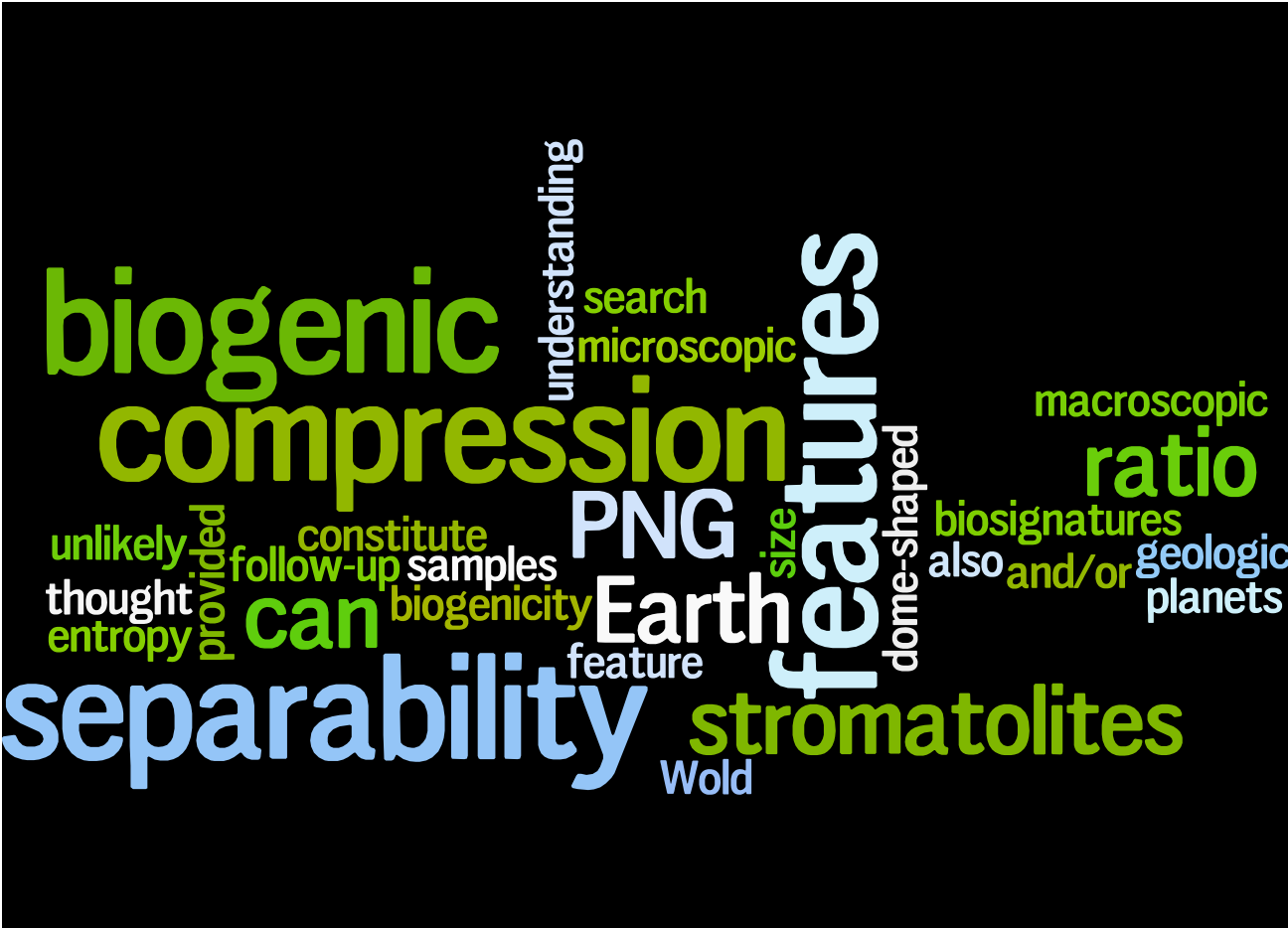
- Constrained Clustering: Advances in Algorithms, Theory,
and Applications.
Edited by Sugato Basu, Ian Davidson, and Kiri L. Wagstaff, Chapman & Hall/CRC Press, 2008.
- Biogenicity Analysis of Stromatolite Structures.
- Papers
-
Multiple-Instance Regression with Structured Data
(pdf, 10 pages, 307K).
Kiri L. Wagstaff, Terran Lane, and Alex Roper.
Proceedings of the 4th International Workshop on Mining Complex Data, December 2008. -
From Protocol Specification to Statechart to Implementation
(pdf, 13 pages, 560K).
Kiri L. Wagstaff, Ken Peters, and Lucas Scharenbroich.
JPL Technical Report, October 2008. -
Automatic Code Generation for Instrument Flight Software
(pdf, 8 pages, 289K).
Kiri L. Wagstaff, Edward Benowitz, DJ Byrne, Ken Peters, and Garth Watney.
Proceedings of the 9th International Symposium on Artificial Intelligence, Robotics, and Automation in Space, February 2008. -
Onboard Detection of Active Canadian Sulfur Springs
(pdf, 8 pages, 235K).
Rebecca Castano, Kiri Wagstaff, Damhnait Gleeson, Robert Pappalardo, Steve Chien, Daniel Tran, Lucas Scharenbroich, Benyang Tang, Brian Bue, and Thomas Doggett.
Proceedings of the 9th International Symposium on Artificial Intelligence, Robotics, and Automation in Space, February 2008. -
Observations of the North Polar Water Ice Annulus on Mars using THEMIS and TES.
Kiri L. Wagstaff, Timothy N. Titus, Anton B. Ivanov, Rebecca Castano, and Joshua Bandfield.
Planetary and Space Science, v. 56, p. 256-265, 2008.
-
Multiple-Instance Regression with Structured Data
(pdf, 10 pages, 307K).
- Abstracts and Posters
-
Automatic Landmark Identification in Mars Orbital Imagery.
Kiri L. Wagstaff, Julian Panetta, Ron Greeley, Norbert Schorghofer, Melissa Bunte, Mary Pendleton Hoffer, and Adnan Ansar.
Eos Transactions of the American Geophysical Union, 89(53), Fall Meeting Supplement, Abstract #P53C-1469, December 2008. -
In Situ Assessment of Potential Biogenicity using Image Analysis.
Kiri L. Wagstaff and Frank Corsetti.
Astrobiology Science Conference, April 2008.
Abstract appears in Advances in Astrobiological Instrumentation Development by Sanjoy Som, Steve Vance, Inge ten Kate, and Andrew Steele. Astrobiology, 8(2): 296-301, 2008.
-
Automatic Landmark Identification in Mars Orbital Imagery.
2007
- Papers
-
On-board Analysis of Uncalibrated Data for a Spacecraft at Mars
(pdf, 9 pages, 849K).
Rebecca Castano, Kiri L. Wagstaff, Steve Chien, Timothy M. Stough, and Benyang Tang.
Proceedings of the 13th International Conference on Knowledge Discovery and Data Mining (KDD), p. 922-930, August 2007. -
Salience Assignment for Multiple-Instance Regression
(pdf, 6 pages, 223K).
Kiri L. Wagstaff and Terran Lane.
Proceedings of the ICML 2007 Workshop on Constrained Optimization and Structured Output Spaces, 2007. - The 2006 SIGART/AAAI Doctoral Consortium.
Kiri L. Wagstaff and Terran Lane.
AI Magazine, vol. 28, no. 1, p. 84-85, 2007. -
Value, Cost, and Sharing: Open Issues in Constrained Clustering
(pdf, 10 pages, 384K).
Kiri L. Wagstaff.
Proceedings of the Fifth International Workshop on Knowledge Discovery in Inductive Databases (KDID 2006), LNCS 4747, p. 1-10, 2007.
-
On-board Analysis of Uncalibrated Data for a Spacecraft at Mars
(pdf, 9 pages, 849K).
- Abstracts and Posters
-
Surface Change Detection from Mars Orbital Imagery.
Baback Moghaddam, Brian D. Bue, Rebecca Castano, and Kiri L. Wagstaff.
Eos Transactions of the American Geophysical Union, 88(52), Fall Meeting Supplement, Abstract #P33A-1020, December 2007. -
County-Level Crop Yield Prediction Using Remote Sensing Data.
Kiri L. Wagstaff, Alex Roper, and Terran Lane.
Eos Transactions of the American Geophysical Union, 88(52), Fall Meeting Supplement, Abstract #B13D-1526, December 2007. -
Automatic Onboard Detection of Planetary Volcanism from Images
(pdf, 2 pages, 173K).
Brian Bue, Kiri L. Wagstaff, Rebecca Castano, and Ashley Davies.
38th Lunar and Planetary Science Conference, March 2007.
-
Surface Change Detection from Mars Orbital Imagery.
2006
- Papers
-
Measuring Constraint-Set Utility for Partitional Clustering Algorithms
(pdf, 12 pages, 276K).
Ian Davidson, Kiri L. Wagstaff, and Sugato Basu.
Proceedings of the Tenth European Conference on Principles and Practice of Knowledge Discovery in Databases (PKDD), p. 115-126, September 2006. -
Active Learning with Irrelevant Examples
(pdf, 8 pages, 395K).
Dominic Mazzoni, Kiri L. Wagstaff, and Michael Burl.
Proceedings of the Seventeenth European Conference on Machine Learning (ECML), p. 695-702, September 2006. -
Learning User Preferences for Sets of Objects
(pdf, 8 pages, 270K).
Marie desJardins, Eric Eaton, and Kiri L. Wagstaff.
Proceedings of the Twenty-Third International Conference on Machine Learning (ICML), p. 273-280, 2006. -
Recent HARVIST Results: Classifying Crops from Remote Sensing Data
(pdf, 5 pages, 197K).
Kiri Wagstaff and Dominic Mazzoni.
Proceedings of the Second NASA Data Mining Workshop, May 2006. - The 2005 SIGART/AAAI Doctoral Consortium.
Kiri L. Wagstaff.
AI Magazine, vol. 27, no. 1, p. 96, 2006.
-
Measuring Constraint-Set Utility for Partitional Clustering Algorithms
(pdf, 12 pages, 276K).
- Abstracts and Posters
-
Real-Time, In-Situ Detection of Dust Devils using Pressure Sensors
(html).
Kiri L. Wagstaff, Rebecca Castano, and Steve Chien.
Eos Transactions of the American Geophysical Union, 87(52), Fall Meeting Supplement, Abstract #IN52A-03, December 2006. -
Fast, Interactive Analysis of Remote Sensing Data with the HARVIST System
(html).
Michael J. Kocurek, Kiri L. Wagstaff, Dominic Mazzoni, Stephan R. Sain, Lucas Scharenbroich, and Timothy M. Stough.
Eos Transactions of the American Geophysical Union, 87(52), Fall Meeting Supplement, Abstract #IN21A-1204, December 2006. -
Automatic Plume Detection for Planetary Bodies (html).
Brian Bue, Kiri L. Wagstaff, Rebecca Castano, and Ashley Davies.
Eos Transactions of the American Geophysical Union, 87(52), Fall Meeting Supplement, Abstract #IN52A-04, December 2006. -
Automating the Detection of Enceladus-Style Plumes (html).
Kiri L. Wagstaff, Becky Castano, Ashley Davies, and Brian Bue.
Division for Planetary Sciences meeting #38, Bulletin of the American Astronomical Society, Vol. 38, p. 522, October 2006. -
When is Constrained Clustering Beneficial, and Why?
(pdf, 2 pages, 71K).
Kiri L. Wagstaff, Sugato Basu, and Ian Davidson.
AAAI Member Abstracts and Posters, Proceedings of the Twenty-first National Conference on Artificial Intelligence (AAAI), July 2006. -
Detecting Dust Storms and Water Ice Clouds Onboard THEMIS (html -- note incorrect citation; should be Spring 2006, not Fall 2007 meeting).
Kiri L. Wagstaff, Joshua L. Bandfield, Rebecca Castano, Steve Chien, Michael D. Smith, and Timothy M. Stough.
Spring AGU Joint Assembly, Revolutionary Space Exploration Concepts using Onboard Computing, May 2006. - Evidence of Life or Not? Scale Sensitive Analysis of
Stromatolite Biogenicity.
Kiri L. Wagstaff and Frank A. Corsetti.
Third Annual Southern California Geobiology Symposium, April 2006. -
Dust Storms and Water Ice Clouds: Feature Detection for Use Onboard THEMIS (pdf, 2 pages, 216K).
Kiri L. Wagstaff, Joshua L. Bandfield, Rebecca Castano, Steve Chien, and Michael D. Smith.
37th Lunar and Planetary Science Conference, March 2006.
-
Real-Time, In-Situ Detection of Dust Devils using Pressure Sensors
(html).
2005
- Papers
-
Semi-Supervised Data Summarization: Using Spectral Libraries to Improve Hyperspectral Clustering
(pdf, 8 pages, 635K).
Kiri L. Wagstaff, Henry P. Shu, Dominic Mazzoni, and Rebecca Castano.
The Interplanetary Network Progress Report, vol. 42-163, 2005. -
Forecasting Space Weather: Predicting Interplanetary Shocks using Neural Networks
(pdf, 5 pages, 244K).
Jon Vandegriff, Kiri Wagstaff, George Ho and Janice Plauger.
Advances in Space Research, vol. 36, issue 12, p. 2323-2327, 2005. -
Active Constrained Clustering by Examining Spectral Eigenvectors
(pdf, 14 pages, 681K).
Qianjun Xu, Marie desJardins, and Kiri L. Wagstaff.
Proceedings of the Eighth International Conference on Discovery Science, p. 294-307, 2005. -
An Onboard Data Analysis Method to Track the Seasonal Polar Caps on Mars
(pdf, 8 pages, 2.8M).
Kiri L. Wagstaff, Rebecca Castano, Steve Chien, Anton B. Ivanov, and Timothy N. Titus.
Proceedings of the International Symposium on Artificial Intelligence, Robotics, and Automation in Space, 2005. -
DD-PREF: A Language for Expressing Preferences Over Sets
(pdf, 7 pages, 597K).
Marie desJardins and Kiri L. Wagstaff.
Proceedings of the Twentieth National Conference on Artificial Intelligence (AAAI), p. 620-626, 2005. -
HARVIST: A System for Agricultural and Weather Studies Using Advanced Statistical Models
(pdf, 5 pages, 3.5M).
Kiri L. Wagstaff, Dominic Mazzoni, and Stephan Sain.
Proceedings of the Earth-Sun Systems Technology Conference (ESTC), 2005. -
Validating Rover Image Prioritizations
(pdf, 8 pages, 354K).
Rebecca Castano, Kiri Wagstaff, Lin Song, and Robert C. Anderson.
The Interplanetary Network Progress Report, vol. 42-160, 2005. -
Constrained Spectral Clustering under a Local Proximity Structure
(pdf, 2 pages, 55K).
Qianjun Xu, Marie desJardins, and Kiri Wagstaff.
Proceedings of the 18th International Florida Artificial Intelligence Research Society (FLAIRS) Conference, p. 866-867, 2005. -
A Context-Sensitive and User-Centric Approach to Developing Personal Assistants
(pdf, 3 pages, 40K).
Marie desJardins, Eric Eaton, and Kiri Wagstaff.
Persistent Assistants: Living and Working with AI (AAAI Spring Symposium), 2005. -
Current Results from a Rover Science Data Analysis System
(pdf, 10 pages, 696K).
Rebecca Castano, Michele Judd, Tara Estlin, Robert C. Anderson, Daniel Gaines, Andres Castano, Ben Bornstein, Tim Stough, and Kiri Wagstaff.
Proceedings of the 2005 IEEE Aerospace Conference, 2005. -
Making the Most of Missing Values: Object Clustering with Partial
Data in Astronomy
(pdf, 5 pages, 85K).
Kiri Wagstaff and Victoria G. Laidler.
Astronomical Data Analysis Software and Systems XIV (ADASS), ASP Conference Series, Vol. 347, 2005.
-
Semi-Supervised Data Summarization: Using Spectral Libraries to Improve Hyperspectral Clustering
(pdf, 8 pages, 635K).
- Abstracts and Posters
-
Revolutionising Science-Driven Deep Space Mission Operations Using Autonomously-Operating Spacecraft as Demonstrated with ASE on EO-1 (html).
Davies, Chien, Doggett, Ip, Dohm, Greeley, Baker, Castano, Sherwood, and Wagstaff.
Eos Transactions of the American Geophysical Union, 86(52), Fall Meeting Supplement, Abstract #P41A-0924, December 2005. -
Compression Analysis and the Biogenic Modification of Abiogenic Substrates (html).
Frank A. Corsetti, Kiri L. Wagstaff, Nicole Bonuso, and Matthew Smith.
Annual Meeting of the Geological Society of America (GSA), 2005. - Structural Biosignature Detection from Rover Images.
Kiri L. Wagstaff and Frank A. Corsetti.
Second Astrobiology Graduate Conference, 2005. -
Towards Onboard Orbital Tracking of Seasonal Polar Volatiles on Mars
(pdf, 2 pages, 115K).
Kiri L. Wagstaff, Rebecca Castano, Steve Chien, Anton B. Ivanov, and Timothy N. Titus.
36th Lunar and Planetary Science Conference, 2005. -
Tracking Retreat of the North Seasonal Ice Cap on Mars: Results from the THEMIS Investigation
(pdf, 2 pages, 860K).
Anton B. Ivanov, Kiri L. Wagstaff, and Timothy N. Titus.
36th Lunar and Planetary Science Conference, 2005.
-
Revolutionising Science-Driven Deep Space Mission Operations Using Autonomously-Operating Spacecraft as Demonstrated with ASE on EO-1 (html).
2004
- Papers
-
Using Trained Pixel Classifiers to Select Images of Interest
(pdf, 8 pages, 262K).
Dominic Mazzoni, Kiri Wagstaff, and Rebecca Castano.
The Interplanetary Network Progress Report, vol. 42-158, 2004. -
Clustering with Missing Values: No Imputation Required
(pdf, 10 pages, 244K).
Kiri Wagstaff.
Classification, Clustering, and Data Mining Applications (Proceedings of the Meeting of the International Federation of Classification Societies), p. 649-658, 2004. -
Mining GPS Traces for Map Refinement
(pdf, 29 pages, 837K).
Stefan Schroedl, Kiri Wagstaff, Seth Rogers, Pat Langley, and Christopher Wilson.
Data Mining and Knowledge Discovery, vol. 9, issue 1, p. 59-87, 2004.
-
Using Trained Pixel Classifiers to Select Images of Interest
(pdf, 8 pages, 262K).
- Abstracts and Posters
-
How to Leverage Existing Spectral Knowledge when Clustering Hyperspectral Data (html).
Kiri Wagstaff, Henry Shu, and Rebecca Castano.
Eos Transactions of the American Geophysical Union, 85(52), Fall Meeting Supplement, Abstract #NG43A-0439, December 2004. -
Science-Based Region-of-Interest Image Compression
(pdf, 2 pages, 68K).
Kiri Wagstaff, Rebecca Castano, Sam Dolinar, Matt Klimesh, and Ryan Mukai.
35th Lunar and Planetary Science Conference, March 2004. -
Multiangle Remote Sensing of Optically Thin Cirrus Clouds from
MISR using Support Vector Machines (html).
Michael Garay, Dominic Mazzoni, Roger Davies, and Kiri Wagstaff.
Spring AGU, Abstract #GC51A-03, 2004.
-
How to Leverage Existing Spectral Knowledge when Clustering Hyperspectral Data (html).
2003
- Abstracts and Posters
-
Automated Analysis of Mars Multispectral Observations
(pdf, 3 pages, 195K).
Kiri Wagstaff and James F. Bell III.
Sixth International Mars Conference, 2003. -
Forecasting Space Weather: Using ACE Data to Provide Real-time
Predictions of High-Intensity Energetic Storm Particle Events
(pdf, 2 pages, 11K).
Kiri Wagstaff, Jon Vandegriff, George C. Ho, and Janice Plauger.
Spring AGU; Geophysical Research Abstracts, vol. 5, p. 14542-3, 2003. -
A Hybrid Global MISR Cloud Mask using Support Vector Machines
and Active Learning.
Michael Garay, Dominic Mazzoni, Roger Davies, Kiri Wagstaff, Dennis DeCoste, and Amy Braverman.
Eos Transactions of the American Geophysical Union, 84(46), Fall Meeting Supplement, Abstract #H11F-0913, December 2003. -
Real-time Upstream Monitoring System: Using ACE Data to
Predict the Arrival of Interplanetary Shocks (html).
Michelle Donegan, Kiri Wagstaff, George C. Ho, and Jon Vandegriff.
Eos Transactions of the American Geophysical Union, 84(46), Fall Meeting Supplement, Abstract #SH42A-0479, December 2003.
-
Automated Analysis of Mars Multispectral Observations
(pdf, 3 pages, 195K).
2002
- Dissertation
-
Intelligent Clustering with Instance-Level Constraints (pdf, 140 pages, 980K)
Kiri L. Wagstaff. Ph.D. Dissertation (Computer Science), Cornell University, 2002.
(See also: a more detailed page with individual chapters)
-
Intelligent Clustering with Instance-Level Constraints (pdf, 140 pages, 980K)
2001
- Papers
-
Constrained K-means Clustering with Background Knowledge
(ps, 8 pages, 225K;
[pdf version]).
Kiri Wagstaff, Claire Cardie, Seth Rogers, and Stefan Schroedl.
Proceedings of the International Conference on Machine Learning (ICML), p. 577-584, 2001. - Generalized Clustering,
Supervised Learning, and Data Assignment (ps, 6 pages, 238K).
Annaka Kalton, Pat Langley, Kiri Wagstaff, and Jungsoon Yoo.
Proceedings of the Sixth International Conference on Knowledge Discovery and Data Mining (KDD), p. 299-304, 2001. -
Multi-document Summarization via Information Extraction
(pdf, 7 pages, 49K).
Mike White, Tanya Korelsky, Claire Cardie, Vincent Ng, David Pierce, and Kiri Wagstaff.
Proceedings of the Human Language Technology (HLT) Conference, 2001. -
Detecting Discrepancies and Improving Intelligibility: Two Preliminary Evaluations of RIPTIDES
(pdf, 16 pages, 49K).
Mike White, Claire Cardie, Vincent Ng, Kiri Wagstaff, and Daryl McCullough.
DUC Workshop on Text Summarization, 2001.
-
Constrained K-means Clustering with Background Knowledge
(ps, 8 pages, 225K;
[pdf version]).
2000
- Papers
- Refining Bias in
Clustering Algorithms via Problem-Specific Constraints
(ps, 17 pages, 284K).
Kiri Wagstaff. Thesis proposal, 2000. -
Clustering with Instance-level Constraints
(ps, 8 pages, 224K;
[pdf version]).
Kiri Wagstaff and Claire Cardie.
Proceedings of the International Conference on Machine Learning (ICML), p. 1103-1110, 2000. -
Alpha Seeding for Support Vector Machines (ps, 5 pages, 205K).
Dennis DeCoste and Kiri Wagstaff.
Proceedings of the Sixth International Conference on Knowledge Discovery and Data Mining (KDD), p. 345-349, 2000.
- Refining Bias in
Clustering Algorithms via Problem-Specific Constraints
(ps, 17 pages, 284K).
- Abstracts and Posters
-
Refining Inductive Bias in Unsupervised Learning via Constraints
(pdf, 1 page, 9K).
Kiri Wagstaff.
AAAI-2000 Doctoral Consortium; Proceedings of the Seventeenth National Conference on Artificial Intelligence (AAAI), p. 1112, 2000. -
Clustering with Instance-level Constraints
(pdf, 1 page, 11K).
Kiri Wagstaff and Claire Cardie.
AAAI-2000 Student Session; Proceedings of the Seventeenth National Conference on Artificial Intelligence, p. 1097, 2000.
-
Refining Inductive Bias in Unsupervised Learning via Constraints
(pdf, 1 page, 9K).
1999
- Papers
-
Noun Phrase Coreference as Clustering (ps, 8 pages, 219K).
Claire Cardie and Kiri Wagstaff.
Proceedings of the Joint SIGDAT Conference on Empirical Methods in Natural Language Processing and Very Large Corpora (EMNLP), p. 82-89, 1999. - Extravehicular Activity Suit
Systems Design: How to Walk, Talk, and Breathe on Mars
(pdf, 22 pages, 485K).
George Barton, Akio Cox, Lauren DeFlores, Alison Diehl, Ari Garber, Randall Goldsmith, Joel Haenlein, Alex Iglecia, Kerri Kusza, Brett Lee, Saemi Mathews, Jonathan Mitchell, Abigail Ross, Rachel Sanchez, Stephen Shannon, Sri Priya Sundararajan, Mike Valdepenas, and Kiri Wagstaff. HEDS-UP, 1999.
-
Noun Phrase Coreference as Clustering (ps, 8 pages, 219K).