Kiri L. Wagstaff
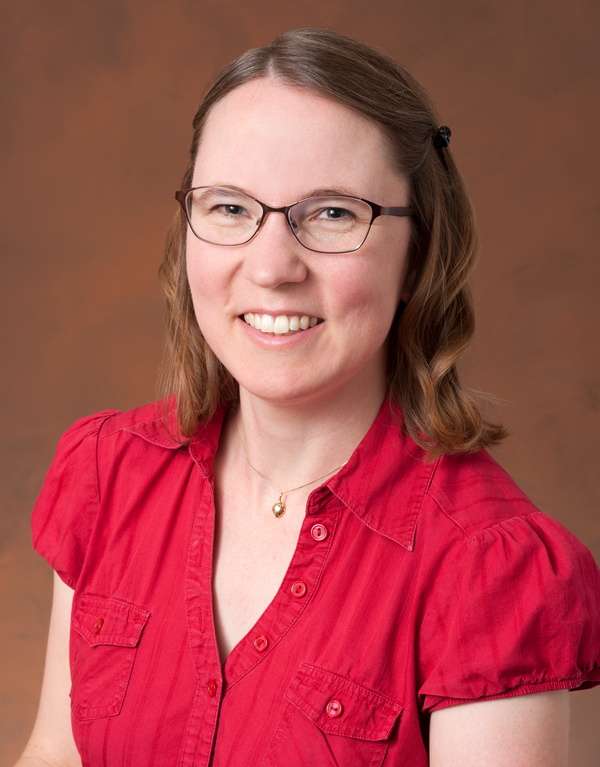
Dr. Kiri Wagstaff is an artificial intelligence researcher and educator with a focus on the real-world impact of machine learning and AI. As a principal researcher at the NASA Jet Propulsion Laboratory, she developed machine learning systems to help us explore, understand, and learn about the universe. She also served as a tactical planner and uplink lead for the Opportunity Mars Exploration Rover and as the PDS Imaging Node Technologist. From 2023-2024, she served as an AI subject matter expert in the U.S. Senate through the AAAS Science and Technology Policy Fellowship program.
Dr. Wagstaff now serves as a Special Advisor on Artificial Intelligence for the Oregon State University Libraries and teaches a graduate course on "Machine Learning Challenges in the Real World." She is passionate about empowering people to make informed decisions about when and how to use AI in their daily lives. She earned a Ph.D. in Computer Science from Cornell University, followed by an M.S. in Geological Sciences (University of Southern California) and an MLIS in Library and Information Science (San Jose State University). She is a Fellow of AAAI, and her other honors include the Lew Allen Award for Excellence in Research and two NASA Exceptional Technology Achievement Medals.
Current activities and news:- Joel Rodriguez is this year's recipient of the Sunflower Scholarship in honor of Lois Oliver at the University of Utah. Congratulations!
- Service and consulting:
- Special Advisor on Artificial Intelligence for the Oregon
State University Libraries
- I invite you to visit our AI Literacy Center!
- We worked with three undergraduate students to create concise, accessible AI literacy videos that you can watch here
- AAAI US Policy Committee
- American Libraries Association (ALA) AI Policy Working Group
- Associate Program Chair for the AAAI 2026 conference
- I served as the Chair
(with Jerry Zhu as Co-chair) of
the
ICML 2025 Position Paper track.
- Browse the 2025 position papers on icml.cc (wait for the page to load) or on OpenReview
- Browse the 2024 position papers on icml.cc (wait for the page to load)
- Learn more about the track in this ICML 2024 behind the scenes chat about position papers (20-minute video).
- AI-ALOE (NSF AI Institute) External Advisory Board
- AI2ES (NSF AI Institute) External Advisory Board
- CMU AI Engineering Study Advisory Panel
- AAAS STPF Fellowships Advisory Committee
- Special Advisor on Artificial Intelligence for the Oregon
State University Libraries
- Recent and upcoming talks:
- What I Learned Serving as an AI Fellow in the U.S. Congress - Jet Propulsion Laboratory (February 10, 2026)
- What do we want out of Artificial Intelligence? - University of Oregon (January 29, 2026)
- Interview about my efforts to increase public AI literacy, my time in the Senate, and my work at JPL by Engineers and Scientists Acting Locally (January 12, 2026)
- The BBC reached out to interview me about space exploration and AI (along with Mike Massimino and Les Johnson). The program aired on January 2, 2026. You can listen to the recording. My part starts about 13:30 (but the whole thing is fascinating).
- How can AI help us explore and understand the universe? - OSU AI Club (November 3) (slides (PDF))
- Elevating Artificial Intelligence Literacy in the Classroom - NWeLearn featured speaker (October 16) (slides (PDF))
- Making Savvy Decisions about Artificial Intelligence in Education - Oregon K-12 teacher in-service day (October 10) (slides (PDF), recording)
- Unfit for Intended Use: Detecting Emergent Bias in Machine Learning Systems - Linköping, Sweden (September 11) (slides (PDF))
- Elevating Artificial Intelligence Literacy for All - Linköping University, Sweden (September 1) (slides (PDF))
- Understanding Artificial Intelligence - Newport Public Library (August 16) (slides (PDF))
- What I Learned as an AI Advisor in the U.S. Congress - AI Policy Summer School, Brown University (July 23) (slides (PDF))
- What do we need to know about artificial intelligence? - Oregon State University's Critical AI Literacy Series (June 24) (slides (PDF))
- The State of AI and Questions We All Should be Asking - Oregon State University's AI Week keynote (April 28) (slides (PDF))
- Recommended:
- Machine Learning that Matters (pdf, 6 pages, 234K, 2012) and the slides from a subsequent invited AAAI talk: Challenges for Machine Learning Impact on the Real World (1.6M).
- What I Learned Serving as an AI Expert in the U.S. Congress (talk recording; October 2024).
- Interview with the How to Do Grad School podcast: Why We Learn, How to Write, & Fostering Collaboration (August 2021, mp3, 42 mins)
- AI legislation and policy (full details):
-
Senators Kelly and Rounds introduced
the Consumers
LEARN AI Act on July 30, 2024. I proposed and developed this
bill with an amazing team for many months. The goal is to help
people make informed decisions about when and where to use AI in
their lives. I'm all about education and empowerment!
- Update: A House companion bill was introduced on Sept. 19, 2024.
- I was interviewed by Nature in May 2024 about my work in Congress as a AAAS Fellow.
- I gave a 10-minute presentation on AI questions before the U.S. Congress at AAAI in February 2024 (my part starts at 27:50).
- I submitted a response to the OSTP's request for information to guide the development of a federal AI Action Plan in March 2025.
-
Senators Kelly and Rounds introduced
the Consumers
LEARN AI Act on July 30, 2024. I proposed and developed this
bill with an amazing team for many months. The goal is to help
people make informed decisions about when and where to use AI in
their lives. I'm all about education and empowerment!
- Recently published or posted:
- Realistic Handwritten Multi-Digit Writer (MDW) Number Recognition Challenges.
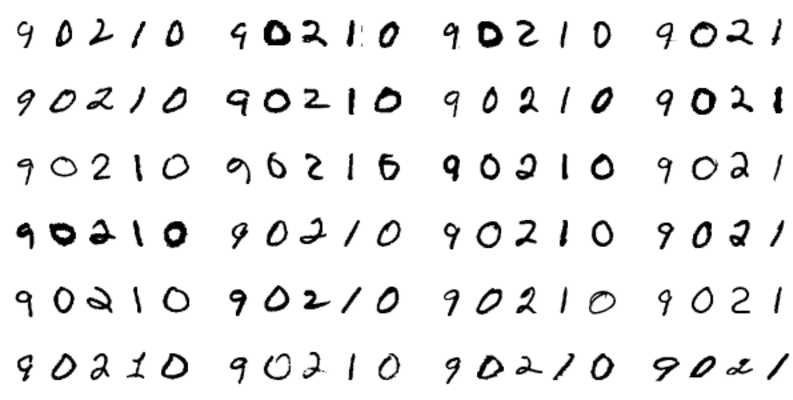
Kiri L. Wagstaff.
arXiv:2512.00676, 2025.- We created three benchmark data sets for the challenging task of recognizing multi-digit handwritten numbers. These include U.S. ZIP Codes, handwritten check amounts, and clock times. Each number is assembled from single-digit examples written by the same human writer. We hope these data sets can inspire the development of methods that can leverage task-specific knowledge to improve performance well beyond that of individual digit classification methods.
- Download the MDW Benchmark Data Sets
- Visit the MDW-handwritten code repository
- All publications
- Automated Classification to Improve the Efficiency of Weeding Library Collections.
Kiri L. Wagstaff and Geoffrey Z. Liu.
Journal of Academic Librarianship, 44(2), p. 238-247, 2018.- We evaluated several machine learning classifiers in terms of their ability to predict which books are most likely to be weeded from a collection. We applied this method to a collection of more than 80,000 items from an academic library and found statistically significant agreement (p = 0.001) between classifier and librarian decisions.
-
Marginalia in the digital age: Are digital reading devices meeting the needs of today's readers?
Melanie Ramdarshan Bold and Kiri L. Wagstaff.
Library & Information Science Research, 39(1), 16-22, 2017.- We surveyed readers to find out about their attitudes toward marginalia, and whether and how often they indulged in it themselves. We also investigated whether marginalia translates into electronic books and which features are most desired by users of e-readers.
- The Early History of the Monrovia Library, my term paper for LIBR 280 (pdf, 16 pages, 1.0M)
- The Evolution of Marginalia, my term paper for LIBR 200 (pdf, 14 pages, 1.1M)
- 2023 Fellow of the Association for the Advancement of Artificial Intelligence (AAAI) for "significant contributions to deployed AI systems in NASA ground and spacecraft operations, AI education, and clustering algorithms."
- 2020 NASA Exceptional Technology Achievement Medal for "inventing dynamic landmarking [to detect surface features from orbital images] leading to novel onboard mission capabilities and infusion into the Planetary Data System"
- 2019 Senior Member of AAAI
- 2017 Calvert N. Ellis Memorial Lectureship from Juniata College in Huntingdon, PA
- I won the 2017 National Adult Spelling Bee!
- I was elected to the AAAI Executive Council for 2015-2018.
- I was promoted to Principal at JPL in January 2015.
- 2014 NASA Group Achievement Award (Mars Exploration Rover Science and Operations Team)
- 2014 NASA Group Achievement Award (IPEX/CP-8 CubeSat Flight Team)
- 2012 NASA Exceptional Technology Achievement Medal for "the development of adaptive data processing techniques for identification of time-varying sources with next-generation radio arrays"
- 2012 AAAI Outstanding Program Committee Member Award (one of four people chosen)
- 2012 Young Alumni Par Excellence Award from the University of Utah
- 2008 Lew Allen Award for Excellence in Research for "advancing the performance and application of machine learning methods to onboard Earth science missions and spacecraft engineering."
- I served as the Director of Flight Operations for the Oregon State Flying Club from 2021-2023.
- I volunteered in support of the Monrovia Public Library and Kids Building Things for several years and at the Corvallis-Benton County Public Library in 2023.
- I completed the Benton County Sheriff's Office Citizens' Academy in 2022.
- I traveled to Guatemala to volunteer with Librarians Without Borders in April 2018.
- I served as Editor in Chief of AI Matters, the SIGAI Newsletter, from April 2014 to June 2015.
- I taught Space Camp to middle school students in South Korea in the summer of 2014.
- I served as part of Crew 89 at the
Mars Desert Research Station, from January 22 to February 7, 2010.
You can read our blog to find out what we did, see pictures, and watch videos!