Abraham Lincoln in Manchester?

While exploring Manchester, I walked into a square in which I was surprised by a tall statue of Abraham Lincoln. Sure, he’s an American icon, but in England? I walked closer to read the inscription at the foot of the statue, and a bit of history unfolded before me. Apparently, Manchester stood by the North during the Civil War, which meant supporting the embargo against the Southern states. This was devastating for Manchester, which produced a phenomenal 98% of the world’s finished cotton (I saw several references throughout the city to Manchester as “Cottonopolis”), and depended heavily on the South for raw cotton imports. As a result, 1861–1865 in Manchester became known as the Lancashire Cotton Famine due to rampant unemployment. Apparently, Britain had abolished slavery in the British Caribbean in 1838. Somewhat depressingly, conditions for those living in Manchester (“Mancunians“) were often no better than those of American slaves (51% mortality for children under 14?!). This may have been part of their motivation in supporting abolition—a chance to make a point about such conditions being insufferable. Lincoln also sent 13,000 barrels of flour to Manchester in 1863 to help feed those who were suffering. The statue’s base records excerpts of a letter from Manchester to Lincoln, and of his reply (see here).

A question lingered in my mind after reading all this, though. Who erected the statue? The Mancunians themselves, to commemorate their own suffering? Or was it a gift from the U.S.? It turns out that the statue was originally destined for London to mark 100 years of peace between the U.S. and England, 1814-1914. A different statue was chosen for London, and Manchester requested that this one go to it instead, citing the Civil War connection. At that time, the statue’s base with the letter excerpts was added.

How unexpected, to go to Manchester and learn something new about the American Civil War. Thank you, Manchester!

Chocolate and Charles Darwin

I’m currently in Manchester, U.K., for the SKA Science and Engineering Meeting (SKA stands for Square-Kilometer Array, a huge next-generation radio telescope array that’s going to be built this generation). I arrived on Saturday around noon local time, after traveling 6,300 miles over about 13 hours (with a layover in Frankfurt in there). Manchester was wet and drizzly, but it was neat to see a place where spring has meaning: little yellow narcissus had sprung up in the park, and white and purple bulbs (crocus?) were just starting to peek out.

To beat jet lag, I needed to stay up until a reasonable bedtime. So I went exploring to the nearby Manchester Museum, which welcomed me to the city with a “Chocolate Big Saturday”. “Big Saturdays” are apparently a periodic event at the museum, and the lure of chocolate distracted me from thinking through what it meant to go to a museum on a Saturday… especially one advertising a chocolate fountain. That’s right, as soon as I stepped inside I was nearly mown down by shrieking children racing around the lobby. I browsed the people showing cacao beans and leaves and how chocolate is made into bars. I was most intrigued by the hand-held spectrometer (like a little pen with a flashing light coming out) that one docent was using to collect and display spectra from M&Ms. I was about to ask if they sold hand-held spectrometers in the gift shop when she commented that this one cost £1,000. I also learned that Smarties (the British version of M&Ms) use only natural dyes (derived from plants) which is why they seem a bit faded or pastel compared to the aggressively supernatural M&M dyes. There was a certain subtext conveyed about British candies being superior to American ones. :)

I then moved on to “The Evolutionist”, a special exhibit on Charles Darwin, complete with comic-book-like (but beautiful) storyboards interspersed with quotes from his writings — some delightfully poetic:

“When looking down from the highest crest of the Cordillera, the mind, undisturbed by minute details, was filled with the stupendous dimensions of the surrounding masses.”

and others rather self-aggrandizing (comments on his own phenomenal powers of observation :) ). The room was full of artifacts, like Darwin’s various collections, and a copy of Charles Lyell‘s “Principles of Geology” (they apparently were friends; Lyell asked Darwin to record the geology he observed in his voyage on the Beagle, which he did). Did you know that Charles Darwin and wife Emma had *ten* children (although two did not survive to adulthood)?

I then went upstairs and saw lots of stuffed animals, a massive sperm whale skeleton (with a very pointy beak!), and a cool historical display on bows and arrows. The museum has an impressive collection of Egypt-related items, including several (real) mummies (not just the coffins). There are thoughtful signs outside the gallery warning those who might not want to view human remains. I was curious, but had to admit that the skeleton with shreds of skin and tissue still on it was pretty creepy. Most of the mummies were almost entirely wrapped, but a few had blackened, shriveled feet sticking out. Finally, I visited the Vivarium, which has lots of live frogs, snakes, and lizards in comfortable habitats. There were also rocks (stromatolites!) and minerals, meteorites and dinosaurs. It was a great, information-filled experience.

I wrapped up the day with a fabulous meal at a local Indian restaurant (Al Bilal), located in the nearby “curry mile”. The food (samosas, garlic naan, saag paneer) was not only delightfully flavored, but seemed to all be made from scratch on the spot. Wow!

What would Thomas Jefferson think?

Thomas Jefferson has a podcast. That’s right, you can now listen to our third President discuss his views on a wide range of subjects in a weekly show, The Thomas Jefferson Hour, that bills itself as “A Radio Program that Models Civil Discourse, Critical Thinking and Good Citizenship.” You can subscribe on iTunes or just browse and listen to individual mp3s.

Today I listened to Episode 761: The Long Now. President Jefferson begins by describing what he feels are the necessary elements of a good conversation: one in which we take time to really connect, we listen to each other, and everyone contributes. There were the obligatory comments about how today’s communication modes are less and less conducive to that kind of conversation, trending towards short exchanges, abbreviations, and interruptions. To that I would add that much of our communication is also more ego-centric: tweeting, blogging, and posting status updates on Facebook are all about pushing out to the world some information about ourselves, not about mutual exchanges or real conversation, even when comment facilities are provided. But I think that is just different, not necessarily bad; those who thrive on deep prolonged conversation with like minds will seek that out anyway, in whatever form they can find it. That said, a reminder is always welcome of the value of slowing down and getting the chance to connect with others through the exchange of ideas and analysis.

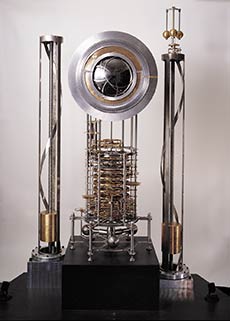
The show then focused on the 10,000 Year Clock being built by The Long Now. The goal of this project is to provide a symbol to inspire all humanity to take the long view. The Clock will provide a reminder to consider the impact of what we do and create, which may reach forward in time hundreds or thousands or more years. Rather than focusing myopically on our narrow lives and their brief extent, we can consider what lies beyond, outside, and long after we are gone. I’m doubly fascinated by this project, because it also served as the inspiration for Anathem, by Neal Stephenson, the best book I read in all of 2009.

But the point of mentioning this project on the TJ Hour was to find out what Thomas Jefferson would have thought of such an endeavor. And we learn that President Jefferson was awfully fond of clocks himself (had 29 in his house, including one too big to fit indoors, so he cut a hole in the floor to let it extend down into the cellar) but that he is skeptical of how a clock, with its fundamental purpose of precisely marking out time, could help us disengage from the ticking moments of the present and think further ahead. He talks at some length about how the very imprecision of clocks in his time went hand in hand with a less frenetic life pace, when days were ruled more by the position of the sun than by an external, ticking, whittling-away sort of device. He also mentions the role clocks played in the Lewis and Clark expedition—an interesting side note that I would have liked to hear more about. I enjoyed his advice about how to slow down time: take an hour’s walk, or grow a garden. Both of these encourage you to let go of your strangle-hold on time, and allow it to stretch out in an organic way. But (in my opinion) while they do also encourage free-wheeling mental activity, which for me often does lead to bigger, weightier thought about my own future, they don’t necessarily prompt me into a centuries- or millennia-long view. I think this clock, for me personally at least, could well provide inspiration more along those lines.

I could not determine from the website how long this show has been running, but given that the most recent episode is #803 and it is a weekly show, I guess it must have been going for something like 15 years! I find that incredible! And it’s a mere 0.15% of 10,000 years! I guess I do need a longer view.

Now if only John Adams would create his own podcast, too.

Great women vagabonders

Traveling holds such a tingling allure, rising up out of the promise of new views, new experiences, and exploring into your personal unknown. I’ve previously written about the concept of vagabonding, an extreme form of travel that involves really living in some new world, not just visiting it, and often for extended periods of time. An isolated page in Vagabonding (by Ralph Potts), titled “The Pioneering Women of Vagabonding,” listed 14 women vagabonders, only one of whom I recognized. Neither did this book provide any information about them—which I took as an opportunity to do a little fun research on who these women were. Here are summaries of and excerpts from the first four on the list:

  • Mary Wollstonecraft (1759-1797) was an accomplished author, philosopher, and feminist. In 1796, she published Letters Written in Sweden, Norway, and Denmark, based on a trip she undertook with her infant daughter, Fanny, to address business negotiations for Fanny’s father, Gilbert Imlay. Truly a courageous vagabonding experience, if ever there were one! An excerpt from one of her letters:

    “The cow’s bell has ceased to tinkle the herd to rest; they have all paced across the heath. Is not this the witching time of night? The waters murmur, and fall with more than mortal music, and spirits of peace walk abroad to calm the agitated breast. Eternity is in these moments. Worldly cares melt into the airy stuff that dreams are made of, and reveries, mild and enchanting as the first hopes of love or the recollection of lost enjoyment, carry the hapless wight into futurity, who in bustling life has vainly strove to throw off the grief which lies heavy at the heart. Good night!”

    She later married William Godwin, who among other things was drawn to her because of this same book. They also had a child together: Mary Wollstonecraft Godwin (later Mary Shelley), who wrote Frankenstein.

  • Isabella L. Bird (1831-1904) is already a great favorite of mine; I’ve very much enjoyed her stories of traveling through Japan (Unbeaten Tracks in Japan, 1880) and Colorado (A Lady’s Life in the Rocky Mountains, 1879). Born in England, she wrote about visits to America, Hawaii, Australia, Japan, Malaysia, Sinai, Persia, Kurdistan, Tibet, Korea, and Morocco. (Really, is there anything beyond her?) She is eloquent, fearless, curious, polite, adventuresome, and successful, and her descriptions of the scenery in which she finds herself are unfailingly, soaringly poetic. You can listen to two of her books read aloud: A Lady’s Life in the Rocky Mountains (delightful!) and The Englishwoman in America (I haven’t read this one yet). She also offers a description of evening:

    “The sinking sun is out of sight behind the western Sierras, and all the pine-hung promontories on this side of the water are rich indigo, just reddened with lake, deepening here and there into Tyrian purple. The peaks above, which still catch the sun, are bright rose-red, and all the mountains on the other side are pink; and pink, too, are the far-off summits on which the snow-drifts rest. Indigo, red, and orange tints stain the still water, which lies solemn and dark against the shore, under the shadow of stately pines. An hour later, and a moon nearly full—not a pale, flat disc, but a radiant sphere—has wheeled up into the flushed sky. The sunset has passed through every stage of beauty, through every glory of color, through riot and triumph, through pathos and tenderness, into a long, dreamy, painless rest, succeeded by the profound solemnity of the moonlight, and a stillness broken only by the night cries of beasts in the aromatic forests.”

  • Alexandra David-Neel (1868-1969) was born in France, but by age 18 had embarked on solo adventures in England, Switzerland, and Spain. She later traveled to India, Tunisia, China, Japan, and others, but seems to have been most drawn to Tibet (and Buddhism). She first crossed into Tibet in 1916, was discovered and sent away, and then re-infiltrated the country in 1924, disguised, for two months.
  • Mary Kingsley (1862-1900) found the opportunity to vagabond in Africa only after both her parents died, freeing her from caring for her invalid mother in England. She collected fish, studied cannibals, and climbed Mt. Cameroon (an active volcano more than 13,000 feet tall). Her Travels in West Africa is available for reading online. She begins with:

    “I succumbed to the charm of the [Gold] Coast as soon as I left Sierra Leone on my first voyage out, and I saw more than enough during that voyage to make me recognise that there was any amount of work for me worth doing down there. So I warned the Coast I was coming back again and the Coast did not believe me; and on my return to it a second time displayed a genuine surprise, and formed an even higher opinion of my folly than it had formed on our first acquaintance, which is saying a good deal.”

Reading their writings, it’s hard not to feel the pull to follow in these women’s footsteps, and enter one’s own foreign lands, wherever they may be.

« Newer entries