May 9th, 2012 at 10:09 pm (Food)
Today I noticed this text on my jar of peanuts:
Scientific evidence suggests but does not prove that eating 1.5 ounces per day of most nuts, such as peanuts, as part of a diet low in saturated fat & cholesterol & not resulting in increased caloric intake may reduce the risk of heart disease.
Got that?
 The phrasing might make one think that peanuts are also low in saturated fat. But according to my jar, 1.5 ounces of them provides 3 grams of saturated fat, or 15% of your US RDA. So as long as that handful of peanuts is only 1/6 of your daily fat consumption, does that count as “low”? Notice you are also not permitted any increase in calories consumed, so if you add the peanuts, you have to take away 260 calories of something else. Or maybe not.
The Peanut Institute (yeah) goes further, calling peanuts “cardioprotective”. Potentially biased sources aside, there does seem to be a pile of studies out there connecting peanut “and tree nut” consumption to decreased heart risk factors (here’s just one). But the waffly nature of the wording struck me as odd.
Although I just noticed it, the FDA approved this “qualified” notice for peanuts in 2003. From the University of Nebraska’s Food Reflections newsletter:
A “qualified” health claim means FDA evaluated the data and determined “though there is scientific evidence to support this claim, the evidence is not conclusive.” A qualified health claim is issued by FDA when it is determined that consumers will benefit from more information on a dietary supplement or conventional food label concerning diet and health even though the claim is based on “somewhat settled science rather than just on the standard of significant scientific agreement, as long as the claims do not mislead the consumers.”
“Somewhat settled science”? Does this mean that there are studies that found different outcomes? I wasn’t able to find any in a quick search of google and google scholar. However, searching for “FDA” and “peanuts” alerted me to a 2009 salmonella outbreak in peanut butter.
I’m also annoyed by the phrasing “most nuts, such as peanuts,” given that peanuts are legumes, not nuts. It *does* seem to be the case that they’re associated with tree nuts in the relevant studies, but still, it’s irritating to see this miscategorization deliberately perpetuated. Would it have been so hard to say “most nuts, as well as peanuts”?
Comments
April 6th, 2012 at 7:39 pm (Animals, Food, History)
Yeah, I blinked at the headline, too. One of my projects at the Monrovia Library is scanning old newspapers (on microfilm) into digital files for easy later access (and hopefully indexing). This item came from the July 2, 1915 issue of the Monrovia Messenger:
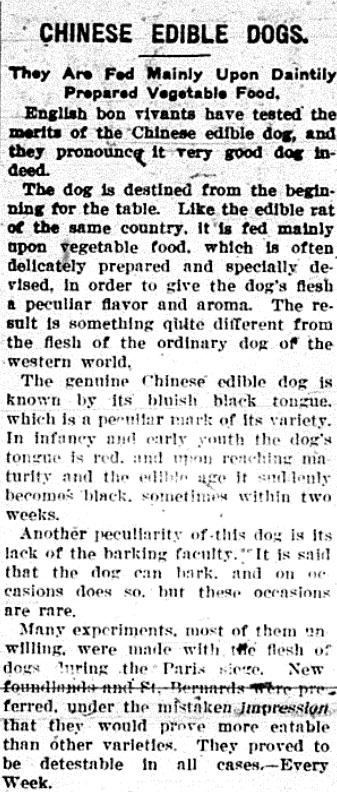
Interesting slice of history!
2 Comments
2 of 2 people learned something from this entry.
January 24th, 2011 at 11:00 pm (Engineering, Food, Plants, Productivity)
I recently had the pleasure of seeing tea being made into tea bags, right before my eyes! While in Boulder, CO, for a conference, I stopped by the Celestial Seasonings tea factory. They have not only a wonderful gift shop but also a free tea-tasting bar filled with great art and a free tour of their factory facilities.
After donning a hair net (plus beard net for whiskered men), we entered the factory and got to see black tea being milled (chopped up), filling the air with the most delicious odors. We walked past bales of herbs piled to the ceiling, filled with hibiscus and chamomile and tilia and all sorts of other things. We entered the tea room, where actual tea (black, green, and white) is stored, and then the “world famous” mint room, which of course is filled with mint. It turns out that a room full of mint bales, kept closed 99% of the time, builds up an overpowering mintness. Two feet into the room, my nose started to tingle and then burn faintly. I couldn’t get back out because of the flow of people coming in, so I edged over to the spearmint side of the room since it was less painful than the peppermint side.
 Next we entered the main assembly room floor. This was so awesome I’m having trouble putting it in words. It was heaven for any tea-loving geek — like Willy Wonka’s Chocolate Factory, but with tea! Little conveyor belts sent half-assembled boxes of tea zooming around the room, pausing to be folded or stamped or sealed or wrapped in plastic, all by amazing automated machines. I wanted to stop and stare and figure out all of their gears and mechanics, but the tour kept pushing onward. Perhaps most intriguing was their “Robotic Palletizer”, which picked up packed cartons tea boxes in groups of six and stacked them precisely on a pallet. Later I saw the whole pallet being spun so it could be wrapped in plastic, a 6-foot stack of tea cartons all wound up like a cocoon. I could have spent the whole afternoon watching this busy, enchanting process.
Right there at the factory, the various herbs and constituents are magically converted into a lovely beverage experience. They mill, mix, and bag the tea (using unique no-string teabags so as to save frightening amounts of paper), then deposit the bags into boxes that are sealed and sent off for distribution and sale. You can get some glimpses of this geeky awesomeness through the Celestial Seasonings virtual tour; click on the tea cups marked “3” and “4”. Enjoy!
2 Comments
2 of 2 people learned something from this entry.
December 4th, 2010 at 10:40 am (Food)
I think we’ve all had the frustrating experience of struggling to open a banana in which the peel won’t split near the stem, which obnoxiously manages to be the strongest part of the fruit — so you pull out a knife to get it started, or just end up mashing the top of the banana in your attempt to get it open. And yet somehow it never occurred to to me to try peeling it… from the other end!
Known as the “monkey method” of peeling a banana, this approach is trivially easy to achieve. You simply pinch or twist at the bottom end of the banana, and it obligingly splits open. I’m astonished that it never even occurred to me to explore better ways to do this. Wow! (Thanks for the tip, Evan!)
| Standard |
Monkey |
 |
 |
Beyond that, there are apparently many strategies for peeling a banana that differ from the “standard” (and apparently suboptimal) approach. I’ve already employed the “thumbnail method” in the past, when a knife was lacking and I was still ineffectually wrangling with the stem end. Now I’m eager to try the “throwing method.” And do read to the bottom of that link to learn about the “pro method.”
6 Comments
3 of 3 people learned something from this entry.
August 28th, 2010 at 5:15 am (Food)
 I recently rediscovered a favorite Australian candy bar of mine, Violet Crumble. It’s made of “honeycomb” on the inside and coated with a thin layer of chocolate. The chocolate provides not only flavor but also function: honeycomb is hygroscopic (absorbs water from the air), and the chocolate forms a barrier to keep water out (and the honeycomb dry and crunchy).
Browsing the food label highlighted some interesting differences between Australia’s take on nutrition and our own. Most of the information is the same, although metric units are used (naturally) and energy is listed in kilojoules rather than calories. The ingredient list caught my eye because it associates a percentage with each item, something I’ve never seen in the U.S. And in this case, Violet Crumble was listed as being 59% chocolate and 40% honeycomb. As you can see from the picture, this clearly is not determined by their volume, but rather something else. I determined via google that these percentages are based on “ingoing weight” (prior to cooking/baking/mixing/preparing).
My candy bar is 17 cm long by 3.5 cm wide by 2.2 cm high (on average), for a total volume of 130.9 cm3. The chocolate layer appears to be about 1 mm thick, yielding a shell volume of ~21 cm3, leaving ~110 cm3 for the honeycomb. The whole bar weighs 50 g, so if we apportion weight using the above percentages, that’s 29.5 g of chocolate and 20 g of honeycomb. We can then determine the density of each, yielding 1.4 g/cm3 for chocolate and 0.18 g/cm3 for honeycomb. The only relevant density report I could find online is a figure of 1.325 g/cm3 for semi-sweet chocolate, so this at least seems reasonable. And just think, all this was possible because Australians include percentages in their ingredient lists!
3 Comments
3 of 3 people learned something from this entry.